


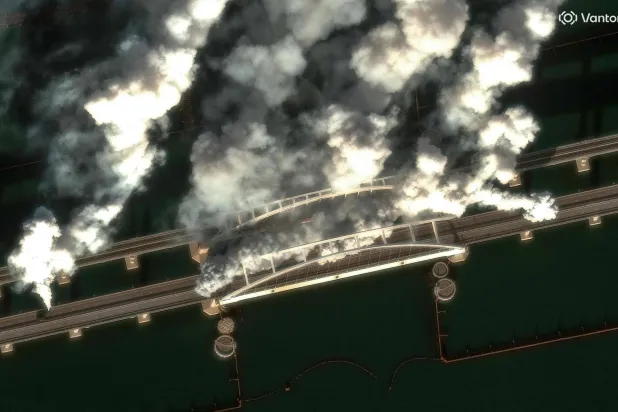
1 Killed in Attack on Crimea as Putin and Zelenskyy Hold Separate Trump Calls
Summarized and contextualized by DistantNews.
At a glance
News
Sources not specified
Context piece
- Analysts suggest US President Donald Trump's NATO summit visit could facilitate Türkiye's acquisition of fighter jet engines but won't resolve the F-35 dispute.
- The visit may lead to the approval of F110 GE engines for Türkiye's KAAN stealth fighter project, potentially removing supply obstacles.
- However, the broader F-35 program dispute, linked to Türkiye's purchase of Russian S-400 missiles, remains unresolved and continues to hamper Turkish defense projects.
Analysts believe President Donald Trump's participation in the upcoming NATO summit in Ankara could be pivotal for Türkiye's defense ambitions, particularly concerning the acquisition of crucial fighter jet engines. While the visit might smooth the path for Türkiye to secure dozens of F110 engines, it is unlikely to resolve the long-standing dispute over the F-35 fighter jet program, which has strained US-Türkiye relations.
It's likely to be the green light for the F110 GE engines for the KAAN fighter plane, about 40 of them. There had been obstacles to that supply and very possibly those are now being removed.
The summit, hosted by President Recep Tayyip Erdogan, brings together leaders from NATO's 32 member states. Trump had previously promised to "make Erdogan very happy" regarding Türkiye's efforts to obtain F110 jet engines and rejoin the F-35 program. Experts suggest this could translate into the green light for approximately 40 F110 GE engines, vital for Türkiye's flagship KAAN stealth fighter project. These engines are needed to increase the number of KAAN platforms, as Türkiye has produced only a few prototypes flying with the F110 engine.
The KAAN fighter is being developed by Turkish Aerospace Industries (TAI) to replace the Turkish Air Force's F-16 fleet and position Türkiye among nations producing fifth-generation combat aircraft. Although Türkiye aims to eventually equip the KAAN with its own domestically produced engine, that project is still in its early stages. The F110 engines, while not stealth-capable, are seen as a necessary interim solution.
Türkiye has produced a couple of prototypes which are flying with the F110 engine, but it has been waiting for the supply of additional engines to increase the number of KAAN platforms.
However, the acquisition of these engines and Türkiye's broader defense projects are complicated by its 2017 purchase of Russia's S-400 missile defense system. This led to Washington expelling Türkiye from the F-35 program in 2019 and imposing CAATSA sanctions a year later. Foreign Minister Hakan Fidan recently emphasized that the CAATSA issue must be resolved, and the US needs to take steps regarding both the F-35 and the KAAN engines, which are awaiting US Congressional approval. This statement caused some surprise, as Türkiye had previously indicated the KAAN would be entirely domestically produced.
The CAATSA issue must be resolved. The US needs to take steps both regarding the F-35 and the engines for KAAN. KAAN's engines are currently awaiting approval in the US Congress.
This exclusion from the F-35 program has compelled Ankara to prioritize self-sufficiency in its defense industry. Some argue that diverting funds from potential F-35 purchases into developing its own fifth-generation fighter, like the KAAN, is the strategic path forward. Without the necessary engines, however, the development and production of the KAAN jet would be significantly hindered. With a delivery date for the KAAN many years away, and only Indonesia having placed an order, the focus remains on securing these critical components.
Some argue we should not buy F-35s and invest that money into our own fifth-generation fighter jet program. And that's exactly what's happening with President Trump's decision to export jet engines.
DistantNews Editorial
Originally published by Asharq Al-Awsat. Summarized and contextualized by our editorial team with added local perspective. Read our editorial standards.
More Stories


From Our Blog

What Gets Lost (and Found) When News Is Translated

The Critical Role of Diaspora Media in Global News

What Travellers Should Know About Countries with Restricted Press

A Digital Nomad's Guide to Following Local News

How the Same Story Looks Different in Different Countries
