


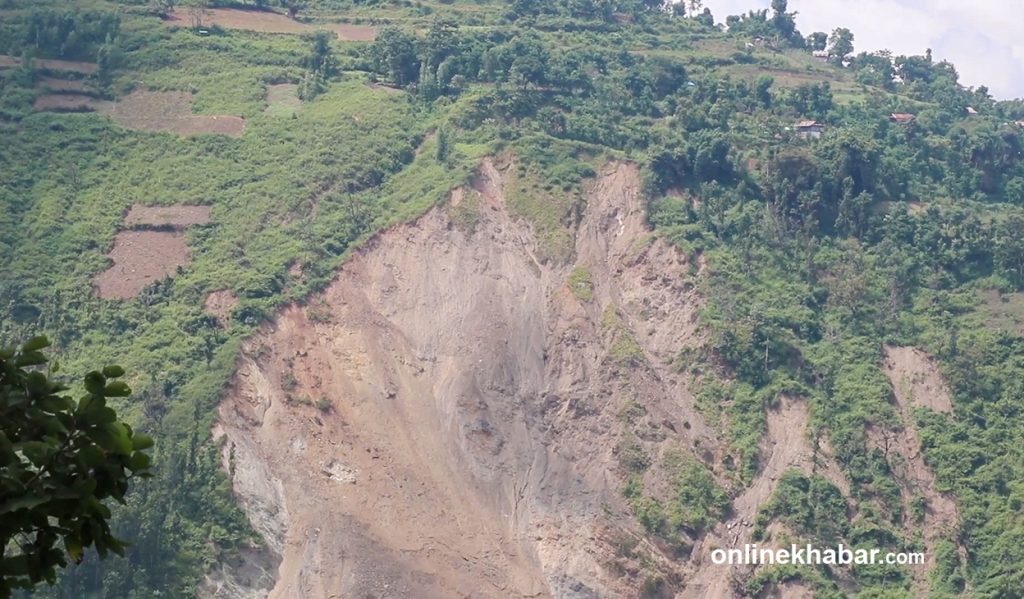
120 families in Nepal's Sangurigadhi face high landslide risk
Translated from English, summarized and contextualized by DistantNews.
At a glance
News
Named sources
Ongoing story
- Approximately 120 families in Sangurigadhi Rural Municipality, Nepal, are at high risk of landslides as the monsoon season begins.
- Over a dozen families have already been displaced, with more facing potential evacuation due to expanding landslides.
- Relocating at-risk families is challenging due to remoteness, limited resources, and a lack of suitable safe locations.
As the monsoon season intensifies, around 120 families in Nepal's Sangurigadhi Rural Municipality face a severe threat from landslides. The region has already seen more than a dozen families displaced, with many more living in constant fear of losing their homes.
the landslide has been expanding because of the steep terrain and erosion caused by streams and rivers on both sides of the village.
Dadhuwa village in Ward No. 7 exemplifies the danger. This settlement, home to about 27 families, is situated between two active landslides. One, on the eastern side, began in 1999 and forced seven families to relocate. While it has stabilized somewhat, the threat to remaining residents persists. A second, more concerning landslide emerged on the western side in 2018, displacing several families and leaving others on the brink of evacuation.
Residents like Jite Rai describe the landslides' expansion as a result of steep terrain and erosion from nearby streams. Fear grips the community each monsoon as increased water flow activates the slides. The risk, however, is year-round, with landslides occurring even during dry periods. This precarious situation is mirrored in other settlements across Sangurigadhi's 10 wards, with Wards 1, 5, 6, 7, and 8 identified as particularly vulnerable.
residents face the monsoon with fear every year because the landslide becomes more active as the flow of water increases.
The rural municipality acknowledges the severity, with technical officer Dipak Rai confirming data showing approximately 120 families at risk. The challenge of rehousing displaced families is compounded by the loss of agricultural land, impacting livelihoods. While the municipality has initiated relocation processes for the most vulnerable, Chairperson Jitendra Rai notes that immediate resettlement for all is hindered by geographical remoteness, scarce resources, and a lack of safe, suitable land. Efforts to mitigate the risk include tree planting and constructing retaining walls, alongside geological studies to inform future risk reduction plans.
immediate relocation of all at-risk families is difficult because of the area’s geographical remoteness, limited resources and lack of suitable safe locations.
DistantNews Editorial
Originally published by OnlineKhabar English in English. Translated, summarized, and contextualized by our editorial team with added local perspective. Read our editorial standards.
More Stories


From Our Blog

What Gets Lost (and Found) When News Is Translated

The Critical Role of Diaspora Media in Global News

What Travellers Should Know About Countries with Restricted Press

A Digital Nomad's Guide to Following Local News

How the Same Story Looks Different in Different Countries
