


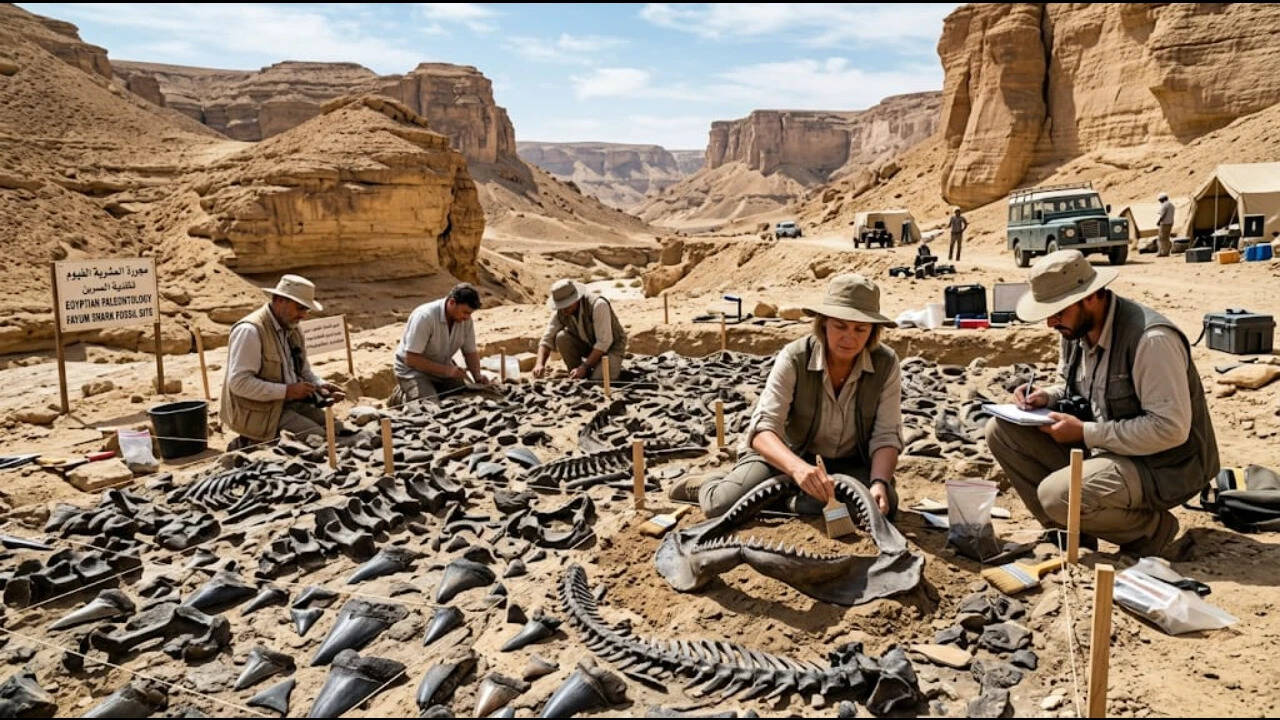
14 fossilised teeth from Egypt reveal five extinct ancient shark species
Summarized and contextualized by DistantNews.
At a glance
News
Named sources
Context piece
- Fossilized shark teeth found in Egypt's Western Desert belong to five extinct species from the Late Cretaceous period.
- The discovery in the Duwi Formation provides new insights into shark diversity in ancient North African seas.
- Researchers identified the species from 14 isolated teeth, highlighting the value of fossilized teeth for paleontological study.
A barren stretch of Egypt’s Western Desert has revealed a prehistoric ocean's secrets, with scientists discovering fossilized shark teeth from five extinct species. These ancient predators lived during the Late Cretaceous period, approximately 83.6 to 72.1 million years ago, when dinosaurs still roamed the Earth. The fossils were unearthed from the Abu-Tartur Plateau in southwestern Egypt, an area now arid but once covered by a warm tropical sea.
The study, published in Cretaceous Research, details a new assemblage of Late Cretaceous lamniform sharks found within the phosphate-rich Duwi Formation. Led by Tarek Yassin of Cairo University, the research team, including Jorge D. Carrillo-Briceño, René Kindlimann, Alhussein Ibrahim, and Mohamed K. AbdelGawad, found that these remains expand the known record of sharks in ancient North Africa. The Duwi Formation's phosphate beds, formed in a tropical marine environment, offer a valuable geological record of the creatures that inhabited these waters.
Researchers recovered 14 isolated lamniform teeth from the phosphate beds in the Maghrabi-Liffiya sector. Shark teeth are frequently preserved due to sharks continuously shedding and replacing them. Despite the small sample size, the distinct characteristics of the teeth allowed scientists to identify five extinct species: Cretalamna cf. C. maroccana, Scapanorhynchus cf. S. raphiodon, Serratolamna cf. S. serrata, Squalicorax bassanii, and Squalicorax pristodontus. The varying tooth shapes suggest a diverse community of predators with different feeding strategies, rather than a group competing for identical resources.
Egyptian shark graveyard: New Late Cretaceous Lamniform shark assemblage from Duwi Formation of Abu-Tartur Area, Southwestern Desert, Egypt
DistantNews Editorial
Originally published by Times of India. Summarized and contextualized by our editorial team with added local perspective. Read our editorial standards.
More Stories



From Our Blog

What Press Freedom Means for the News You Read

What Gets Lost (and Found) When News Is Translated

The Critical Role of Diaspora Media in Global News

What Travellers Should Know About Countries with Restricted Press

A Digital Nomad's Guide to Following Local News
