


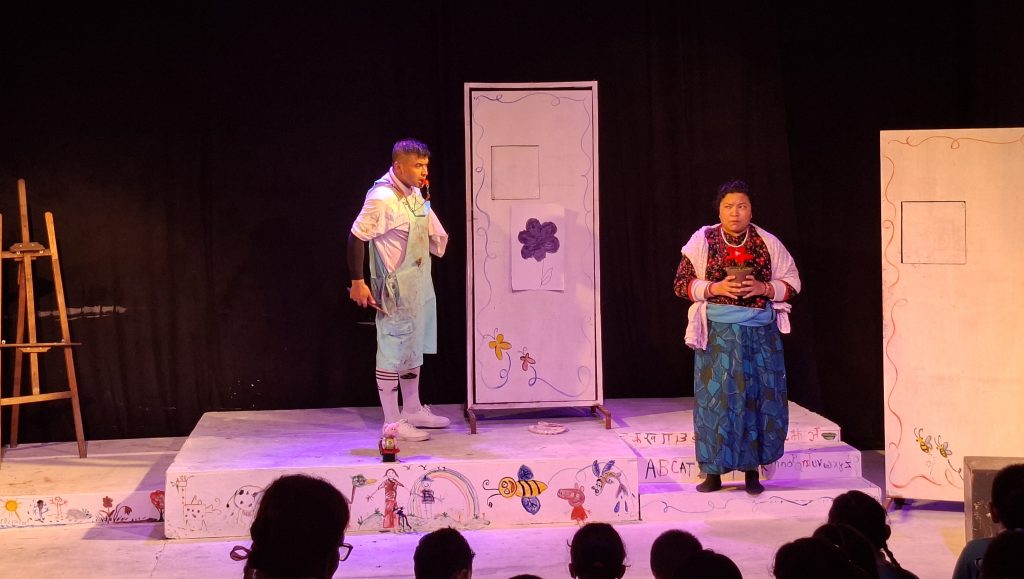
A Sweet Apple reminds us that every perspective matters
Summarized and contextualized by DistantNews.
At a glance
In-depth
Sources not specified
Context piece
- The play "A Sweet Apple" at the Mandala Theatre explores how diverse perspectives arise from everyday observations.
- It highlights the conflict between children's intuitive understanding and rigid adult expectations.
- The production, written and directed by Kedar Shrestha, emphasizes the importance of acknowledging children's unique viewpoints for better family communication.
The play "A Sweet Apple," currently staged at the Mandala Theatre, offers a compelling exploration of how differing perspectives shape our understanding of reality. The production illustrates that what seems simple or obvious to one person can be complex or entirely different for another, often leading to confusion or conflict. However, the play, written and directed by Kedar Shrestha, posits that these "mismatches" are a natural outcome of individual perspectives, reflecting creativity and critical thinking.
Through scenes where a young boy draws a red sun and a brown leaf, challenging his mother's conventional views, "A Sweet Apple" demonstrates how an unexpected viewpoint can transform a simple observation. The boy's justifications, the morning sun can be red, and fallen leaves are brown, serve as powerful reminders that a different answer is not necessarily incorrect. The play underscores that reality is perceived through the lens of our context.
The morning sun is red.
Adapted from Shrestha's original story "Guliyo Syau," the semi-non-verbal play captures the quiet tension between a child's intuitive psychology and the rigid expectations imposed by parents. While appealing to children, it carries a vital message for adults: the necessity of listening to and acknowledging a child's unique point of view. The play suggests that understanding these early perspectives is fundamental to fostering open and effortless family communication.
In its concise 45-minute runtime, "A Sweet Apple" delivers profound life lessons often overlooked in formal education. Beyond entertainment, it aims to enhance children's problem-solving, communication, listening, and decision-making skills. The story's enduring relevance is evident in its international success, with the book selling over 3,000 copies in Nepali, translations into multiple languages, and a recent tour to Mongolia, with further international performances planned.
The play vividly illustrates how everyday objects spark diverse perspectives.
DistantNews Editorial
Originally published by OnlineKhabar English. Summarized and contextualized by our editorial team with added local perspective. Read our editorial standards.
More Stories


From Our Blog

What Gets Lost (and Found) When News Is Translated

The Critical Role of Diaspora Media in Global News

What Travellers Should Know About Countries with Restricted Press

A Digital Nomad's Guide to Following Local News

How the Same Story Looks Different in Different Countries
