

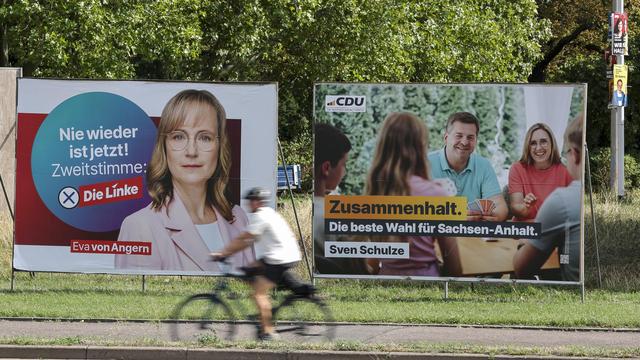

AfD in Saxony-Anhalt: The Party’s Policies Harm Its Own Voters
Translated from German and summarized by DistantNews. Read the original for the full story.
At a glance
Analysis
Documents & data
Context piece
- The AfD could form a state government and provide Saxony-Anhalt’s minister-president after the September 6 election, according to the article’s scenario.
- A DIW Berlin comparison found the AfD sharply diverges from other parties across six policy areas, especially social issues and climate policy.
- The analysis argues that restrictions on skilled immigration, democracy programs and social infrastructure conflict with the party’s claim to represent workers and lower-income voters.
The Alternative for Germany could make a historic breakthrough in Saxony-Anhalt by forming a state government and supplying the minister-president after the September 6 election. But an analysis by DIW Berlin argues that the party’s program could deepen the problems facing the voters it claims to represent.
The study compares 38 Wahl-O-Mat statements with party positions in the 2016 and 2021 state elections and the 2025 federal election. It finds that the party system has changed fundamentally, with the distance between the AfD and the other parties wider than ever. At the same time, the AfD is losing its former policy distinctiveness.
Across taxes and the economy, climate, social policy, society, domestic affairs, and Europe and international affairs, the AfD in Saxony-Anhalt stands clearly apart from the average position of the other parties. The sharpest gap appears in social issues. The party supports a traditional family model in schools, seeks to ban gender-inclusive spelling, and rejects separate statistical recording of femicides.
Its climate policy is similarly pronounced. The AfD opposes expanding wind power, rejects measures aimed at climate neutrality, and wants to reverse the coal phaseout. The article says that could directly affect Saxony-Anhalt’s economy, which includes a large chemical industry dependent on affordable energy and ranks among Germany’s leading states for renewable energy expansion.
The analysis describes a contradiction in the party’s social policy. People and businesses need skilled workers, functioning local infrastructure, good schools, affordable housing and dependable health care. The AfD supports some popular measures, such as free student transport, lower child-care costs and public hospitals. Yet it opposes key conditions for maintaining that social infrastructure, including recruiting skilled workers from abroad.
It also supports cuts to projects against far-right extremism and for democratic education. The party opposes a wealth tax and, in some cases, tools for social housing and training finance. The article presents this as a central contradiction for a party that portrays itself as the voice of workers and ordinary people.
About this summary
Originally published by Die Zeit in German. Translated, summarized, and contextualized automatically by DistantNews, with a note on how the source frames the story. Not individually reviewed before publishing. How this works.
More Stories

From Our Blog

News in Translation: What Gets Lost, and How We Keep the Framing

The Same Story, Different Countries: How Coverage Changes at the Border

Diaspora Media: How Communities Abroad Follow Home

Traveling Where the Press Is Not Free: How to Read the News There

The Digital Nomad's Guide to Local News
