


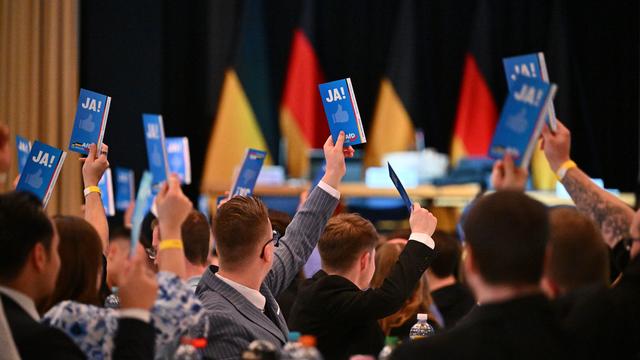
AfD politicians propose revising party's extremism list
Translated from German, summarized and contextualized by DistantNews.
At a glance
News
Sources not specified
New plan
- Several Alternative for Germany (AfD) politicians, including Thuringia's state chairman Björn Höcke, propose revising the party's list of incompatible organizations.
- The proposed changes aim to remove the reliance on the Office for the Protection of the Constitution's assessments and establish the AfD's own definition of extremism.
- Critics argue the proposed definition is too narrow and not aligned with constitutional or academic standards, potentially excluding few organizations.
Thuringia's AfD leader Björn Höcke and other party members are pushing to overhaul the AfD's "incompatibility list," which determines membership eligibility. A proposal submitted for the party's federal congress in Erfurt seeks to decouple the list from assessments by the Office for the Protection of the Constitution. Instead, the applicants want the AfD to define extremism on its own terms.
This is not an extremism definition that is covered by constitutional and scientific definitions.
The proposed definition states that only organizations with a program aimed at abolishing parliamentary democracy and establishing a dictatorship, coupled with planned, active, and militant action to achieve these goals, would be considered extremist. This definition specifically includes a commitment to or systematic use of violence.
Furthermore, the proposal suggests adding parties and groups that contradict the AfD's core beliefs to the incompatibility list, citing the Green Party as an example. It also advocates for a statute of limitations, meaning past membership in an extremist organization for ten or more years would no longer disqualify someone from joining the AfD.
It is a definition narrowed to violence and putschism, which in this form applies to almost no organization.
However, political scientist Wolfgang Schroeder of the Berlin Centre for Social Research criticized the proposal, telling RTL/ntv that it does not align with constitutional and academic definitions of extremism. He described it as a definition narrowed to violence and "putschism," which would apply to almost no organizations in its current form. This is not the first time Höcke and his co-state chairman Stefan Möller have called for a list revision, arguing in 2022 that its focus was too narrow.
in its focus too much narrowed
DistantNews Editorial
Originally published by Die Zeit in German. Translated, summarized, and contextualized by our editorial team with added local perspective. Read our editorial standards.
More Stories

From Our Blog

What Gets Lost (and Found) When News Is Translated

How the Same Story Looks Different in Different Countries

The Critical Role of Diaspora Media in Global News

What Travellers Should Know About Countries with Restricted Press

A Digital Nomad's Guide to Following Local News
