


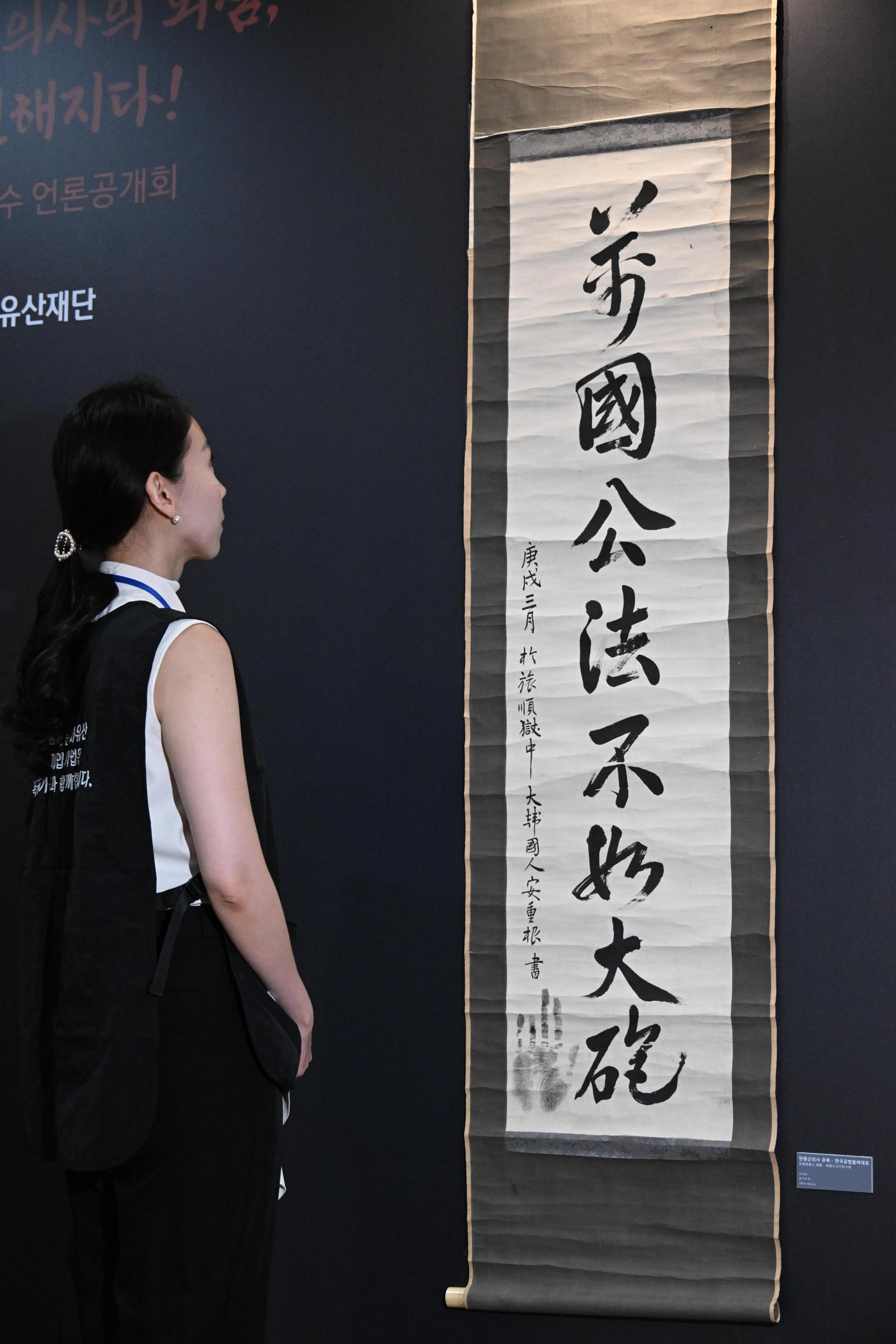
Ahn Jung-geun's calligraphy, 'International Law is Inferior to Cannons,' revealed for the first time
Translated from Korean, summarized and contextualized by DistantNews.
At a glance
News
Sources not specified
Outcome reported
- Ahn Jung-geun's calligraphy work, 'International Law is Inferior to Cannons,' created shortly before his execution, has been publicly displayed for the first time in Korea.
- The work, created in 1910, expresses his deep skepticism towards the 'logic of power' that rendered international law ineffective.
- The calligraphy, bearing Ahn's fingerprint and written in his distinctive style, was recovered from Japan and is now housed by the Cultural Heritage Administration.
A calligraphy work by Ahn Jung-geun, titled 'International Law is Inferior to Cannons' (만국공법불여대포), created in the prison cell just before his execution in March 1910, has been unveiled to the public for the first time since its repatriation from Japan. The Cultural Heritage Administration and the Overseas Korean Cultural Heritage Foundation presented the artwork on Tuesday at Deoksugung Palace's Jungmyeongjeon Hall in Seoul.
The phrase 'International Law is Inferior to Cannons' reflects Ahn's profound disillusionment with international law, which he saw as powerless against the 'logic of power' wielded by imperial nations. This sentiment contrasts with his advocacy for peace and order in East Asia based on international law, as articulated in his treatise 'On Peace in the East' (동양평화론), written in the same Lüshun Prison. Despite his actions at Harbin Station in October 1909, where he assassinated Itō Hirobumi, Ahn maintained he was acting as a commander of the Korean Righteous Army and demanded a trial under international law, but Japanese authorities prosecuted him for murder.
The artwork prominently features Ahn's distinctive fingerprint on the lower left. Above it, the inscription reads, 'Written by Ahn Jung-geun, a Korean, in Lüshun Prison in the third month of Gyeongsul (1879-1910).' The calligraphy, penned just days before his execution on March 26, 1910, showcases a blend of semi-cursive and cursive script, with the character '萬' (man, meaning ten thousand) written in a cursive style also seen in his other works, a characteristic unique to Ahn.
Records on the back of the calligraphy indicate its provenance, noting it was once owned by Kurihara Sadakichi, the warden of Lüshun Prison, who reportedly held a favorable view of Ahn and requested a delay in his execution to allow him to complete 'On Peace in the East.' Another inscription mentions that 'Pyungmun Kwangsaeng, a madman of Pyungmun, and Naehyup Il-in (평문광생 뇌협일인)' preserved the work out of pity for Ahn's plight. This individual, from the Pyung clan, is described as someone unburdened by worldly gains.
Park Jeong-hye, chairperson of the Overseas Korean Cultural Heritage Foundation, stated, "We hope this serves as an opportunity to reflect on the sacrifices and aspirations of our ancestors for independence and to inspire national pride." The foundation pledged to continue its systematic efforts to discover and repatriate Korean cultural heritage from abroad, sharing its value with the public.
We hope this serves as an opportunity to reflect on the sacrifices and aspirations of our ancestors for independence and to inspire national pride.
DistantNews Editorial
Originally published by Dong-A Ilbo in Korean. Translated, summarized, and contextualized by our editorial team with added local perspective. Read our editorial standards.
More Stories


From Our Blog

What Gets Lost (and Found) When News Is Translated

The Critical Role of Diaspora Media in Global News

What Travellers Should Know About Countries with Restricted Press

A Digital Nomad's Guide to Following Local News

How the Same Story Looks Different in Different Countries
