


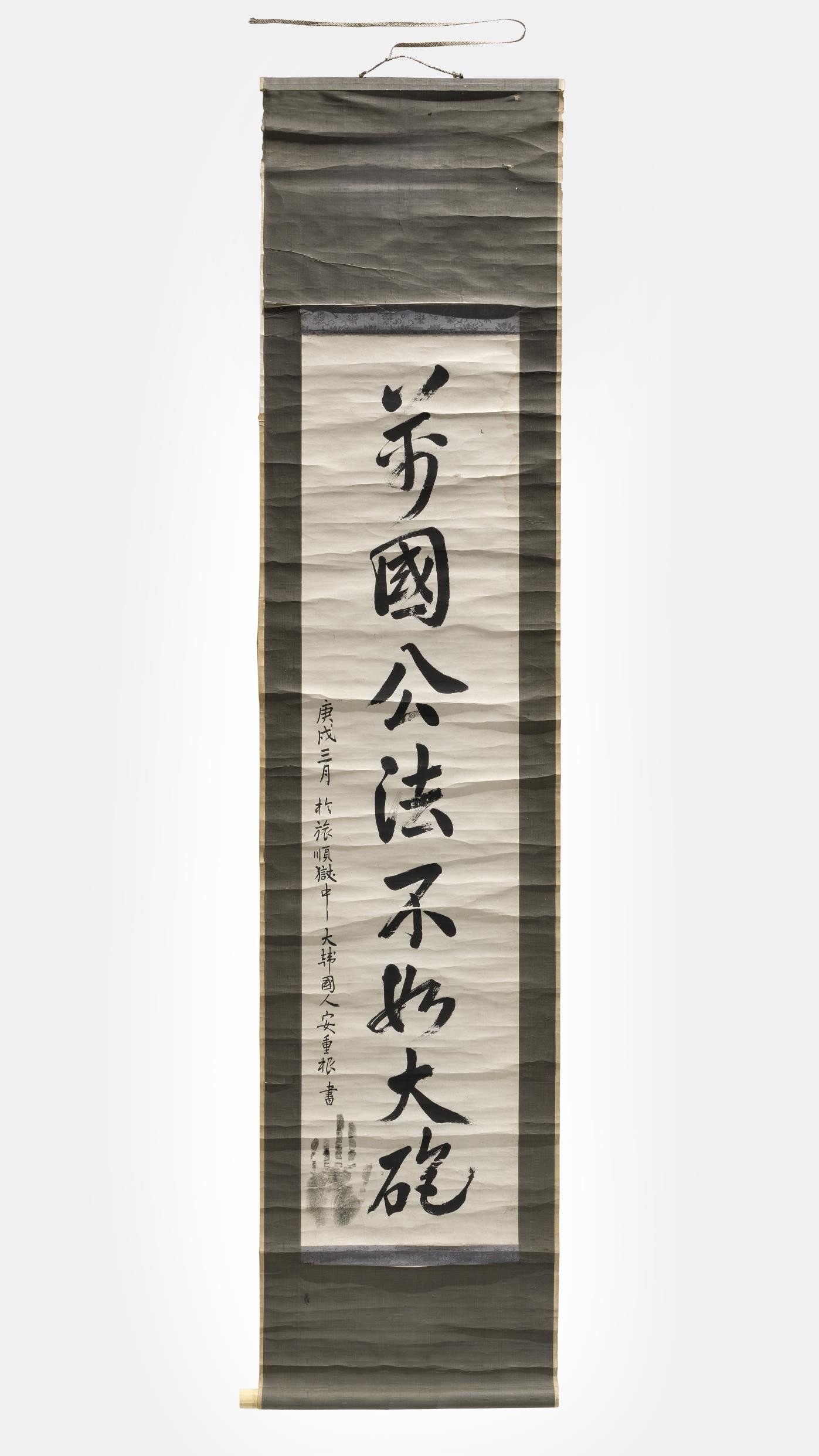
Ahn Jung-geun's final words: 'International law is worse than cannons,' to be displayed in Korea
Translated from Korean, summarized and contextualized by DistantNews.
At a glance
News
Official statement
New plan
- A calligraphy piece by Ahn Jung-geun, created shortly before his execution, is being publicly displayed in South Korea for the first time.
- The artwork, titled 'International Law is Worse Than Cannons,' conveys Ahn's criticism of the impotence of international law against imperial powers.
- The piece, written in 1910, is part of a collection of cultural heritage repatriated from Japan.
A poignant calligraphy piece by Korean independence activist Ahn Jung-geun, penned just before his execution, is making its debut public display in South Korea. The artwork, bearing the inscription 'International Law is Worse Than Cannons,' encapsulates Ahn's disillusionment with the ineffectiveness of international legal frameworks when confronted by the might of imperialist forces.
Created in March 1910 while Ahn was imprisoned in Luda prison awaiting his execution on March 26, the calligraphy measures 196.8 cm in length and 44.8 cm in width. It bears the inscription indicating it was written by Ahn Jung-geun, a Korean patriot, in Luda prison in March of the year Gyeongsul (1910).
The phrase 'Man-guk Gong-beop bul-yeo dae-po' (만국공법불여대포), meaning international law is inferior to cannons, is derived from a 19th-century Japanese thinker, Fukuzawa Yukichi. It reflects a critique of the era's reality, where imperial powers invoked international law while prioritizing the logic of force. Ahn's unfinished work, 'The Principle of East Asian Peace,' also touches upon his hopes for peace and order in East Asia based on international law.
The repatriation of this significant artifact from Japan, facilitated by the Cultural Heritage Administration and the Overseas Korean Cultural Heritage Foundation, marks a crucial moment in reclaiming national heritage. Its unveiling, two days before the 81st anniversary of Korea's liberation, underscores its historical and emotional weight for the nation.
DistantNews Editorial
Originally published by Dong-A Ilbo in Korean. Translated, summarized, and contextualized by our editorial team with added local perspective. Read our editorial standards.
More Stories


From Our Blog

What Gets Lost (and Found) When News Is Translated

The Critical Role of Diaspora Media in Global News

What Travellers Should Know About Countries with Restricted Press

A Digital Nomad's Guide to Following Local News

How the Same Story Looks Different in Different Countries
