


America's emptying armories signal a strategic decline
Translated from Korean, summarized and contextualized by DistantNews.
At a glance
Analysis
Named sources
Context piece
- The U.S. military faces a structural crisis as its ammunition stockpiles dwindle, signaling a potential "strategic menopause" for its global dominance.
- The Iran conflict has significantly depleted key precision-guided munitions, requiring years to replenish and exposing vulnerabilities in the U.S. defense industry's "Just-In-Time" production model.
- This depletion of U.S. military power is being exploited by adversaries like Iran and Russia, raising questions about the reliability of U.S. extended deterrence for allies.
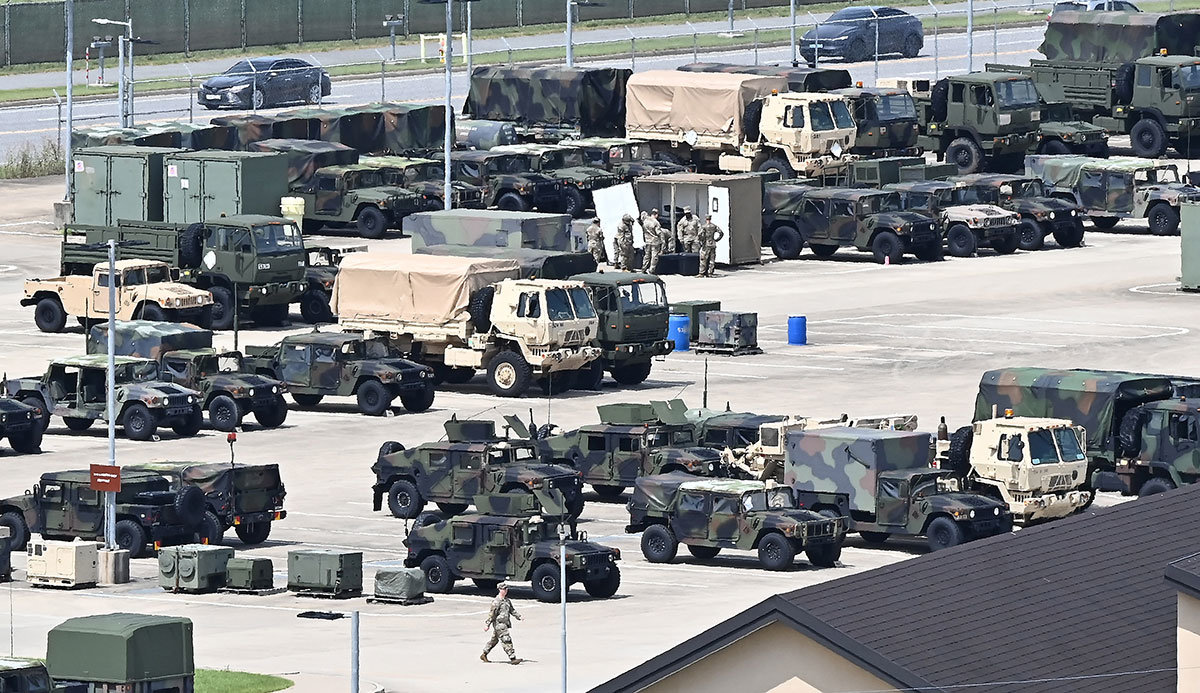
The United States military is facing a critical shortage of ammunition, a situation described as a "strategic menopause" that threatens its global hegemonic status. This is not merely a temporary setback from recent conflicts but a deep-seated structural crisis that has been building for years.
The war in Ukraine and the recent conflict with Iran have severely depleted U.S. stockpiles of essential precision-guided munitions. Analyses suggest that the Iran conflict alone consumed between a third and over half of certain key weapon systems. Replenishing these stocks to pre-war levels could take anywhere from three years to the early 2030s, depending on the system. Compounding this issue, even pre-conflict reserves were insufficient to handle a large-scale war with China or Russia. The U.S. defense industry's reliance on "Just-In-Time" production, prioritized for efficiency and cost savings during peacetime, has proven fatally flawed for sustained, multi-front conflicts.
Bottlenecks in the production of components like solid rocket motors, advanced seekers, and specialized castings, along with a shortage of skilled labor, cannot be resolved quickly. Furthermore, the U.S. is heavily dependent on foreign supply chains for semiconductors and rare earth minerals crucial for high-precision weapons. As one senior fellow at the Center for Strategic and International Studies put it, the U.S. has become "a nation where the speed of consumption of ammunition outpaces the speed of creation."
Adversaries are keenly aware of this U.S. vulnerability. Iran has leveraged the perceived depletion of U.S. military assets, particularly Patriot and THAAD missile systems in the Gulf, to make aggressive demands for sanctions relief and military withdrawal. In Ukraine, Russia is exploiting the U.S. inability to supply sufficient interceptor missiles, leading to a "holed shield" and enabling large-scale missile attacks on Kyiv.
This erosion of U.S. military capacity has significant implications for the Asia-Pacific region. Washington's strategy may shift from "Simultaneous Deterrence" to a more constrained "limited intervention through selection and focus." This raises a critical question for allies: how long can they unconditionally rely on the U.S. extended deterrence, or "nuclear umbrella," when the U.S. itself faces such profound material limitations?
The U.S. has become 'a nation where the speed of consumption of ammunition outpaces the speed of creation.'
DistantNews Editorial
Originally published by Hankyoreh in Korean. Translated, summarized, and contextualized by our editorial team with added local perspective. Read our editorial standards.
More Stories

From Our Blog

What Gets Lost (and Found) When News Is Translated

The Critical Role of Diaspora Media in Global News

What Travellers Should Know About Countries with Restricted Press

A Digital Nomad's Guide to Following Local News

How the Same Story Looks Different in Different Countries
