


Archaeologists Uncover Croatia's Largest Prehistoric Hill Fort, Potential for Tourism Boost
Translated from Croatian, summarized and contextualized by DistantNews.
At a glance
News
Named sources
New plan
- Archaeologists have discovered what is believed to be the largest prehistoric hill fort in Croatia, Gradina Slanje – Stari Gradec.
- The site spans approximately 12.5 hectares and features impressive ramparts reaching up to 14 meters high.
- The discovery holds significant potential for regional archaeological research and the development of continental tourism.
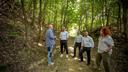
Archaeologists are astonished by the discovery of Gradina Slanje – Stari Gradec, a prehistoric hill fort believed to be the largest of its kind in Croatia. Located in a wooded area between Vinogradi Ludbreški and Slanje, on the northern slopes of Kalnik, the monumental fortification's sheer scale initially surprised even experts. The site covers approximately 12.5 hectares and is encircled by a system of ditches and massive earthen ramparts that reach heights of up to 14 meters.
We have 14-meter-high ramparts behind us, and we are in the ditch of the northeastern part of the hill fort, which extends over 12.5 hectares, thus the size of the Knin Fortress, which is the largest medieval fortress in Croatia.
For comparison, its area is nearly equivalent to that of the Knin Fortress, Croatia's largest medieval fortification. Gradina Slanje – Stari Gradec, along with sites in Martijanec and Jalžabet, forms a unique Iron Age landscape in the Varaždin County. Dr. Saša Kovačević, a senior research associate at the Institute of Archaeology in Zagreb, described the discovery as surprising due to its dimensions. "We have 14-meter-high ramparts behind us, and we are in the ditch of the northeastern part of the hill fort, which extends over 12.5 hectares," Kovačević stated.
The site also includes a necropolis with tumuli from the Early Iron Age. Kovačević emphasized the institute's holistic approach, which integrates research with protection and future presentation of the findings. He mentioned ongoing work at a large settlement in Martijanec spanning 40 hectares, also featuring a necropolis with tumuli. The scale of the Gradina Slanje discovery surpassed expectations, even for Minister of Justice, Public Administration, and Digital Transformation Damir Habijan, who was aware of other local archaeological sites.
This is huge potential, not only in terms of archaeology in this area but I think it is also huge potential for the development of continental tourism, in which I think Varaždin County is investing a lot of effort.
"This is huge potential, not only in terms of archaeology in this area but I think it is also huge potential for the development of continental tourism, in which I think Varaždin County is investing a lot of effort," Habijan remarked. County Prefect Anđelko Stričak highlighted the ongoing collaboration between Varaždin County and the Institute of Archaeology since 2016. He noted that after researching the tomb of a ruler from the East Hallstatt culture in Jalžabet, investigations continued in Martijanec and Slanje. The county has prepared documentation for the tomb's restoration and the construction of an interpretation center, anticipating further findings that will shed light on the lives of the area's inhabitants from the 5th to 7th centuries BC.
We are eagerly awaiting further archaeological findings to see how the inhabitants of that time lived in this area.
DistantNews Editorial
Originally published by Večernji List in Croatian. Translated, summarized, and contextualized by our editorial team with added local perspective. Read our editorial standards.
More Stories



From Our Blog

What Gets Lost (and Found) When News Is Translated

The Critical Role of Diaspora Media in Global News

What Travellers Should Know About Countries with Restricted Press

A Digital Nomad's Guide to Following Local News

How the Same Story Looks Different in Different Countries
