


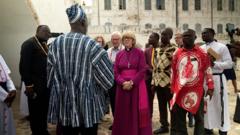
Archbishop of Canterbury confronts Church's slave trade past in Ghana
Translated from English, summarized and contextualized by DistantNews.
At a glance
News
Sources not specified
Context piece
- The Archbishop of Canterbury visited Cape Coast Castle in Ghana, a former slave trading post.
- The visit highlighted the Church of England's historical involvement in the transatlantic slave trade.
- The Church has previously apologized for its associations with slavery and is committed to a £100 million slavery fund.
The Archbishop of Canterbury, Dame Sarah, has undertaken a pastoral visit to Africa, with a significant focus on reparative justice during her time in Ghana. Her visit included a stop at Cape Coast Castle, a historic site that served as a major hub for the transatlantic slave trade under British control since the 1660s.
During her visit, Dame Sarah was shown the dungeons where enslaved people were held and the infamous "door of no return," from which they were forced onto ships. She described the experience as deeply moving, stating, "You can't help but be deeply moved by the horrific conditions that people were kept in and the way that they were treated. It completely throws you off balance and brings home the evil that was transatlantic slavery."
You can't help but be deeply moved by the horrific conditions that people were kept in and the way that they were treated. It completely throws you off balance and brings home the evil that was transatlantic slavery.
Above the dungeons lies a chapel, which the Archbishop noted serves as a "stark illustration of the way the church was involved in the slave trade." This acknowledgment underscores the historical entanglement of the Church of England with the slave trade. The Church's missionary arm operated slave-worked plantations in the Caribbean to finance the expansion of Anglicanism, clergy members were individual slave owners, and the Church itself received substantial donations from slave traders.
The Church of England has previously issued apologies for its historical ties to the slave trade. As part of its commitment to addressing this legacy, the Church is dedicated to a £100 million slavery fund, aiming to contribute to reparative justice efforts.
A stark illustration of the way the church was involved in the slave trade.
DistantNews Editorial
Originally published by BBC News in English. Translated, summarized, and contextualized by our editorial team with added local perspective. Read our editorial standards.
More Stories



From Our Blog

What Gets Lost (and Found) When News Is Translated

The Critical Role of Diaspora Media in Global News

What Travellers Should Know About Countries with Restricted Press

A Digital Nomad's Guide to Following Local News

How the Same Story Looks Different in Different Countries
