


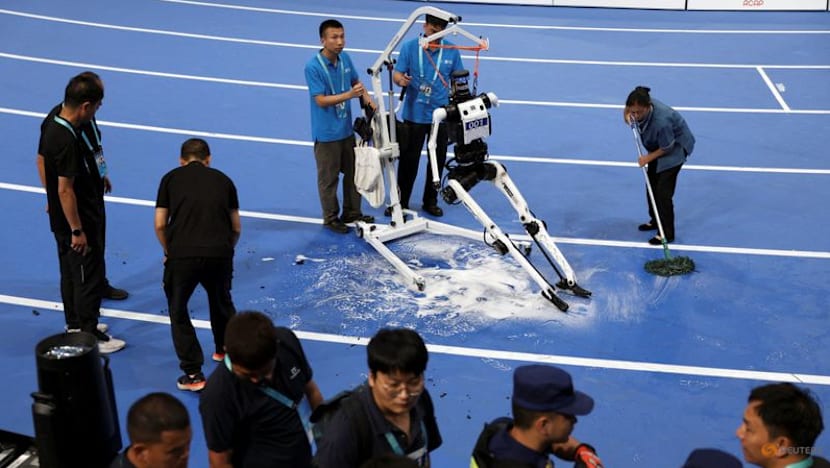
At China's 'robot Olympics', humanoids spar, sprint and perform taichi
Summarized and contextualized by DistantNews.
At a glance
News
From a news agency
New plan
- China hosted the World Humanoid Robot Games, featuring 51 events combining sports and simulated work scenarios.
- Robots demonstrated impressive speed, with some exceeding Usain Bolt's 100m world record, though braking remained a challenge.
- The games aim to advance China's industrial sector by testing robots in complex tasks and real-world problem-solving.
China's burgeoning robotics sector showcased its advancements at the World Humanoid Robot Games in Beijing. The five-day event featured 51 competitions, blending athletic challenges with practical simulations of factory, restaurant, and office environments. This initiative highlights China's ambition to lead in industrial robotics.
The intensity is higher than last year, which places significant demands on the robot's battery management and thermal dissipation capabilities.
Robots at the games achieved remarkable feats, with some models clocking faster times in the 100m sprint than Usain Bolt's world record. However, the spectacle was tempered by practical limitations, such as robots crashing into safety mats after crossing the finish line. Similar challenges were noted in longer races, indicating that while speed is improving, control and braking require further development.
Beyond the athletic events, the games emphasized robots' ability to navigate the complexities of the physical world. Competitions included tasks like packaging, warehouse operations, and precision work such as connecting cables. These scenarios test robots' object recognition, precise manipulation, and error recovery capabilities, crucial for their integration into industrial settings. Huawei, a key tech partner, noted that over 40% of the events required full autonomy, underscoring the drive towards independent robotic operation.
It holds huge significance for the development of China's industrial sector.
Spectators and investors, like robotics investor Xu Qiaosheng, see significant implications for China's industrial development. The games not only serve as a platform for technological display but also as a crucial testing ground for hardware improvements and real-world applicability. Lumos Robotics CEO Yu Chao emphasized that the true value lies in robots' capacity to solve practical problems in end-user scenarios, pushing the boundaries of what humanoid robots can achieve.
Only when it can work in those end scenarios does it have real value
DistantNews Editorial
Originally published by CNA. Summarized and contextualized by our editorial team with added local perspective. Read our editorial standards.
More Stories


From Our Blog

What Gets Lost (and Found) When News Is Translated

The Critical Role of Diaspora Media in Global News

What Travellers Should Know About Countries with Restricted Press

A Digital Nomad's Guide to Following Local News

How the Same Story Looks Different in Different Countries
