


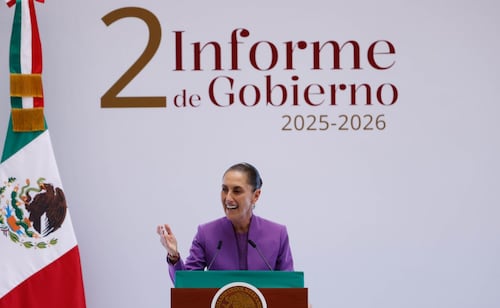
 Image: Diego Simón Sánchez/ EL UNIVERSAL
At her second report, Claudia Sheinbaum gives culture and science two minutes
Translated from Spanish and summarized by DistantNews. Read the original for the full story.
At a glance
News
Official statement
Context piece
- President Claudia Sheinbaum devoted two minutes of her second government report to culture and science.
- She highlighted 20 strategic innovation projects, including the Olinia electric vehicle, Kutsari semiconductors, Ixtli satellites and the Quetzal unmanned aircraft.
- She also cited increased research support, expanded overseas scholarships and cultural initiatives involving books, reading groups and arts education.
Claudia Sheinbaum devoted a total of two minutes to culture and science during her second government report. She began with science, presenting “sovereign innovation” as a government vision aimed at development for everyone.
She said the government had assembled teams of professors, researchers, students and public higher-education institutions to work on 20 strategic projects. Among them, she highlighted the Olinia mini electric vehicle, which has entered its production phase, the Kutsari semiconductor project, and the Ixtli Earth-observation satellites.
She also mentioned an ocean monitoring and climate-protection system, as well as Quetzal, a project to build a new-generation unmanned aerial vehicle. She reported a 193% increase in support for scientific research projects, a 70% rise in overseas scholarships and a 23% increase in postdoctoral placements.
promote sovereign innovation, which translates into development for everyone
Another initiative, the Mexican Diaspora Chair, has brought 900 Mexican academics living abroad into teaching and research collaboration in Mexico. She also announced the start of Coatlicue, described as a project to develop “the most powerful supercomputer in Latin America,” with an estimated capacity of 314 billion operations per second.
On culture, Sheinbaum cited progress in arts education, including the removal of fees at schools run by the National Institutes of Fine Arts and Literature and Anthropology and History. She mentioned the Cinematography Training Center’s new Chapultepec campus and said the Carlos Chávez School had its own location for the first time in 37 years. She ended by noting that the Economic Culture Fund published 2.5 million books for young people in 14 countries and promoted more than 26,000 reading groups.
the most powerful supercomputer in Latin America
About this summary
Originally published by El Universal in Spanish. Translated, summarized, and contextualized automatically by DistantNews, with a note on how the source frames the story. Not individually reviewed before publishing. How this works.
More Stories



From Our Blog

What Press Freedom Means for the News You Read

What Gets Lost (and Found) When News Is Translated

The Critical Role of Diaspora Media in Global News

What Travellers Should Know About Countries with Restricted Press

A Digital Nomad's Guide to Following Local News
