


Atmosphere detected on Earth-like exoplanet LHS 1140 b
Translated from Romanian, summarized and contextualized by DistantNews.
At a glance
News
Sources not specified
New plan
- Astronomers detected an atmosphere on the exoplanet LHS 1140 b, located 40 light-years away.
- This discovery provides strong evidence for Earth-like worlds capable of hosting life beyond our solar system.
- The planet's atmosphere is primarily helium, with other elements potentially trapped at lower altitudes.
Scientists have detected an atmosphere on the exoplanet LHS 1140 b, a rocky world orbiting a red dwarf star 40 light-years from Earth. This finding marks a significant step in the search for potentially habitable worlds beyond our solar system.
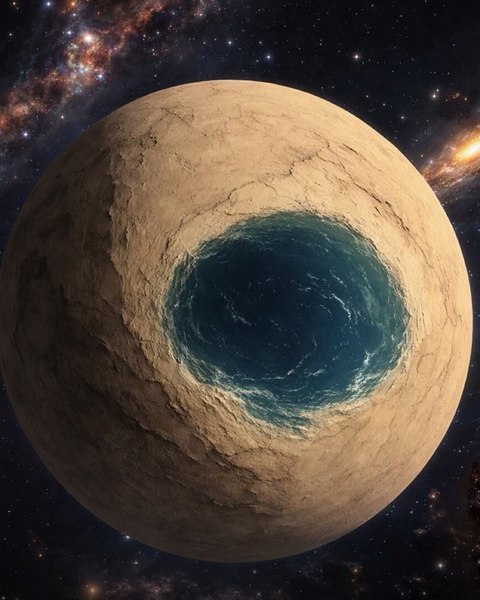
What we believe, and what the new data seem to confirm, is that LHS 1140 b is a planet halfway between an ocean planet (covered entirely by water, with oceans hundreds of kilometers deep) and an ice giant similar to Uranus and Neptune, composed mainly of hydrogen.
The exoplanet, discovered in 2017, is about 5.6 times the mass of Earth and 1.7 times its radius. It orbits its star every 24.7 days and receives about 42% of the stellar radiation Earth receives. These characteristics suggest a temperature suitable for liquid water, a key ingredient for life as we know it.
Researchers used the Magellan Clay telescope in Chile to detect signs of helium escaping LHS 1140 b's atmosphere in 2024. This helium-rich atmosphere, poor in hydrogen, suggests the planet may be a transitional world between an ocean planet and a gas giant like Uranus or Neptune. While water is suspected to be present at lower altitudes, its existence and the planet's surface conditions remain subjects for further study.
Helium was clear evidence of the existence of an atmosphere on an exoplanet located in the habitable zone. It was absolutely thrilling to observe the transit spectra and gradually realize the implications of what we were observing.
This detection is particularly noteworthy as previous atmospheric detections on exoplanets have typically found compositions similar to Uranus or Neptune, not Earth. "Finally! It was about time we detected signs of an atmosphere on an Earth-like planet," said Jose Antonio Caballero, an expert at the Spanish Astrobiology Center. The team also observed another planet in the system, LHS 1140 c, but found no evidence of an atmosphere there.
Finally! It was about time we detected signs of an atmosphere on an Earth-like planet. The truth is that LHS 1140 b had all the chances to be the first, but astronomers had tried many times before, without success.
DistantNews Editorial
Originally published by Adevărul in Romanian. Translated, summarized, and contextualized by our editorial team with added local perspective. Read our editorial standards.
More Stories



From Our Blog

What Gets Lost (and Found) When News Is Translated

The Critical Role of Diaspora Media in Global News

What Travellers Should Know About Countries with Restricted Press

A Digital Nomad's Guide to Following Local News

How the Same Story Looks Different in Different Countries
