


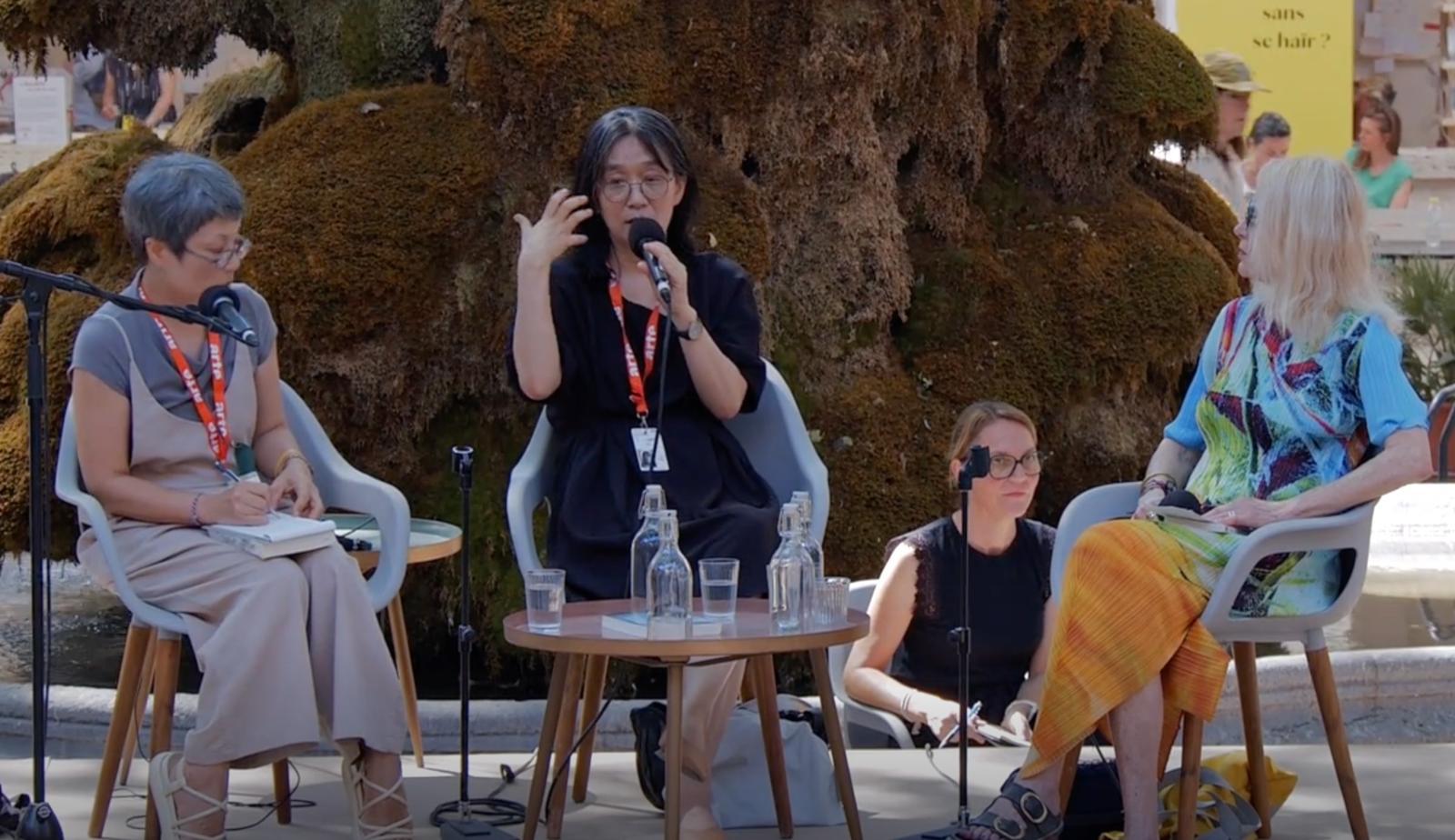
Author Han Kang Discusses Universal Themes of Violence and Mourning in Her Novels at Avignon Festival
Translated from Korean, summarized and contextualized by DistantNews.
At a glance
News
Sources not specified
Context piece
- Author Han Kang discussed her novels "I Want to Live" and "Farewell, Not Saying Goodbye" as a "pair of books" exploring universal themes of human violence and mourning.
- She emphasized that the books address recurring violence throughout human history, not just specific national histories.
- Kang explained her principle of relying on fragmented testimonies from survivors rather than conducting direct interviews to avoid re-traumatizing them.
Author Han Kang described her novels "I Want to Live" and "Farewell, Not Saying Goodbye" as a connected pair, delving into the profound themes of human violence and the enduring process of mourning.
Speaking at the Avignon Festival in France, Kang stated that these works are not solely confined to Korean history. Instead, she aims to explore the universal nature of violence that has recurred throughout human existence and the subsequent grief experienced by those left behind. "Just as the Earth is connected by water, we are all connected," Kang explained, highlighting her intention to write about the cyclical nature of violence and the persistent acts of remembrance and farewell that follow.
I Want to Live and Farewell, Not Saying Goodbye are connected, and can be called a pair of books.
Kang also shared her distinct approach to portraying historical violence. She explained that the fragmented testimonies of survivors were crucial to her writing process for both novels. "When a person experiences an event, they experience it in fragments," she noted, emphasizing her effort to immerse herself within these fragments to capture the raw experience.
I don't think 'I Want to Live' and 'Farewell, Not Saying Goodbye' only deal with Korean history. I think they speak about universal humans.
A key principle for Kang is her refusal to directly interview survivors. "I did not want to reopen their wounds," she stated, explaining that survivors have already shared their experiences. Her method involves meticulously reading these existing testimonies, striving to inhabit the emotional landscape of those who endured the events, rather than seeking direct accounts that might cause further pain.
Kang further characterized "Farewell, Not Saying Goodbye" as a novel moving "from death to life," likening it to a story of lighting a candle underwater or people braving a snowstorm to save a bird. The recurring imagery of snow and water in her work reflects a sense of interconnectedness, suggesting that the elements and human experiences are part of a continuous cycle. The conversation also touched upon the role of literature in offering a hand toward life, even when confronting the most despairing narratives, suggesting that shared moments of truth in reading can forge connections among people.
I didn't want to reopen their wounds, because they had already testified. I tried my best to read those testimonies and be in that experience, and that's all.
DistantNews Editorial
Originally published by Dong-A Ilbo in Korean. Translated, summarized, and contextualized by our editorial team with added local perspective. Read our editorial standards.
More Stories

From Our Blog

What Gets Lost (and Found) When News Is Translated

The Critical Role of Diaspora Media in Global News

What Travellers Should Know About Countries with Restricted Press

A Digital Nomad's Guide to Following Local News

How the Same Story Looks Different in Different Countries
