


🇰🇷
South Korea
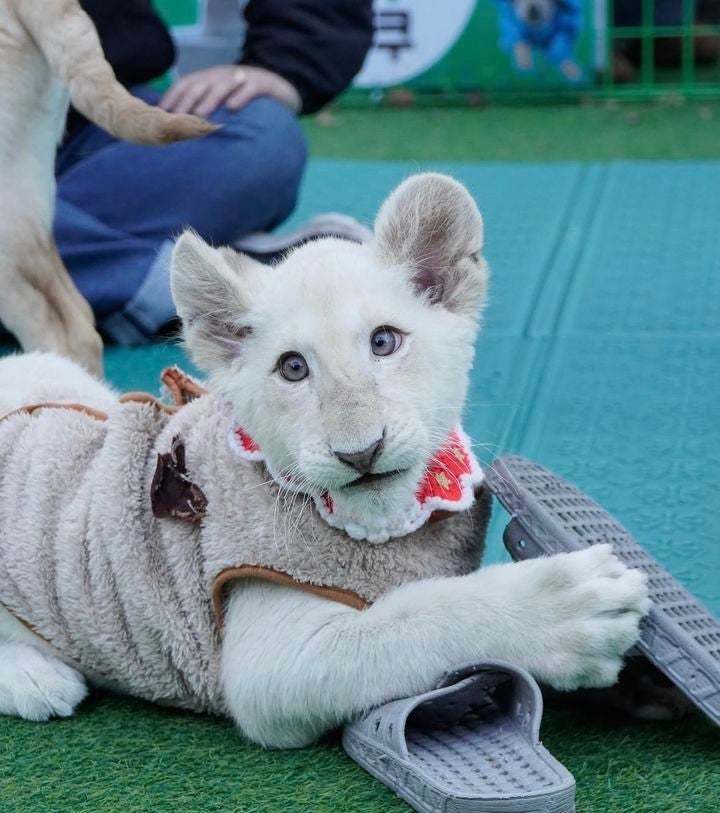
Baby White Lion 'Bom-i' Dies; Inbreeding Criticized
Translated from Korean, summarized and contextualized by DistantNews.
TLDR
- A baby white lion named 'Bom-i' died at the Daejeon Aquarium at the age of seven months.
- The lion succumbed to a worsening of a congenital condition known as 'multiple cartilaginous exostoses'.
- Animal rights groups criticized the breeding practices, citing potential issues arising from inbreeding due to the rarity of white lions.
The Dong-A Ilbo reports with sadness on the passing of 'Bom-i,' a baby white lion at the Daejeon Aquarium, at just seven months old. While the immediate cause was a worsening of a congenital condition, 'multiple cartilaginous exostoses,' the incident has reignited concerns about the ethics of breeding rare animals like white lions.
White lions are not naturally common creatures, so repeated inbreeding continues to be controversial to maintain rarity. Indeed, it has been consistently pointed out that such breeding structures can lead to various health problems, including congenital diseases and skeletal abnormalities.
White lions, a rare genetic mutation from South Africa, are often bred in captivity to maintain their unique appearance. However, as pointed out by the Daejeon Environmental Movement Federation, this pursuit of rarity can lead to inbreeding, resulting in significant health problems and skeletal abnormalities. The group argues that Bom-i's death cannot be viewed merely as an unfortunate accident but as a consequence of a breeding system that prioritizes exhibition over the animal's well-being.
We cannot view Bom-i's death as merely an unfortunate accident, and we must ask who this breeding is for. The justification of endangered species conservation often arises, but this incident is closer to consuming rarity for exhibition than a symbol of species conservation.
This tragedy, following other incidents involving animals at the O-World (which includes the Daejeon Aquarium), such as a wolf's escape and a puma's death, prompts a critical re-evaluation of how zoos and aquariums function. The Dong-A Ilbo, reflecting a growing sentiment among local environmental groups, calls for a shift from 'consuming' animals for display to creating spaces focused on rescue, rehabilitation, conservation, and ecological restoration. The hope is that Bom-i's death will serve as a catalyst for meaningful change in the management and purpose of such facilities, moving beyond mere entertainment to genuine animal welfare and species preservation.
We must stop exhibiting the suffering of wild animals. The escape of the wolf showed the limits of 'confinement,' and Bom-i's death shows the violence of 'creation.'
DistantNews Editorial
Originally published by Dong-A Ilbo in Korean. Translated, summarized, and contextualized by our editorial team with added local perspective. Read our editorial standards.
More Stories


From Our Blog

What Gets Lost (and Found) When News Is Translated

The Critical Role of Diaspora Media in Global News

What Travellers Should Know About Countries with Restricted Press

A Digital Nomad's Guide to Following Local News

How the Same Story Looks Different in Different Countries
