


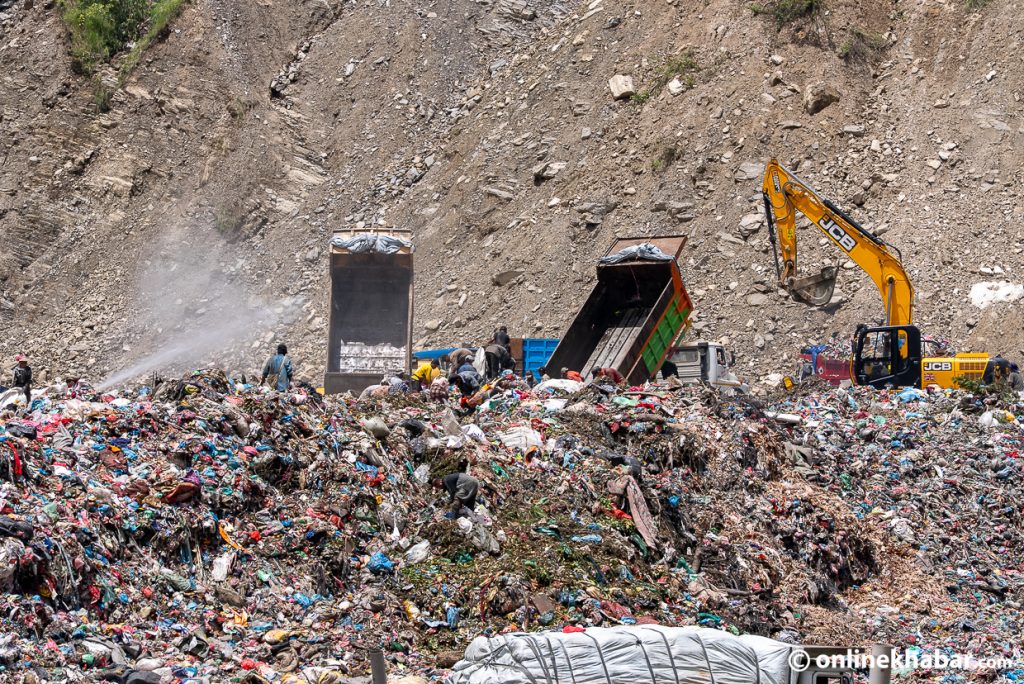
Bancharedanda was built to solve Kathmandu’s waste problem. Four years later, it is becoming another Sisdol
Summarized and contextualized by DistantNews.
At a glance
In-depth
Named sources
Context piece
- The Bancharedanda landfill, intended to solve Kathmandu's waste problem, is rapidly deteriorating four years after opening.
- Leachate is overflowing into the Kalpu River, and foul odors plague nearby communities.
- Poor waste segregation, inadequate infrastructure, mismanagement, and a lack of local government responsibility have contributed to the crisis.
Four years after its opening, the Bancharedanda landfill, designed to address Kathmandu Valley's mounting waste crisis, is rapidly becoming another Sisdol, a dumping ground it was meant to replace. Towering piles of waste are now overflowing with leachate, a toxic liquid that has begun contaminating the Kalpu River as the dam built to contain it has filled. Residents living near the landfill describe a "hellish life" dominated by the stench of rotting waste and the unsettling presence of crows and kites dropping animal remains near their homes.
Opened on May 24, 2022, the Bancharedanda site was intended as a sanitary landfill, scientifically managed to last for 20 years. However, it is already overwhelmed, receiving waste from 21 local governments within and around the Kathmandu Valley. An investigation reveals that a combination of factors, including poor waste segregation at the source, insufficient infrastructure, irregular management, and a failure of local governments to assume responsibility, has pushed the facility towards a crisis.
We are living a hellish life alongside the stench.
The sanitary landfill was constructed at a cost of over 1 billion Nepalese rupees by the Ministry of Urban Development and handed over to Kathmandu Metropolitan City for management. Officials from the federal government state that the metropolitan city failed to implement the scientific waste management system for which the landfill was designed. The facility was intended to receive only non-biodegradable waste, and even then, only materials that could not be reused or recycled. Instead, mixed waste has been transported to Bancharedanda, indicating a fundamental misunderstanding of the difference between a properly managed landfill and a mere dumping site.
The difference between a dumping site and a landfill was not understood.
DistantNews Editorial
Originally published by OnlineKhabar English. Summarized and contextualized by our editorial team with added local perspective. Read our editorial standards.
More Stories


From Our Blog

What Gets Lost (and Found) When News Is Translated

The Critical Role of Diaspora Media in Global News

What Travellers Should Know About Countries with Restricted Press

A Digital Nomad's Guide to Following Local News

How the Same Story Looks Different in Different Countries
