


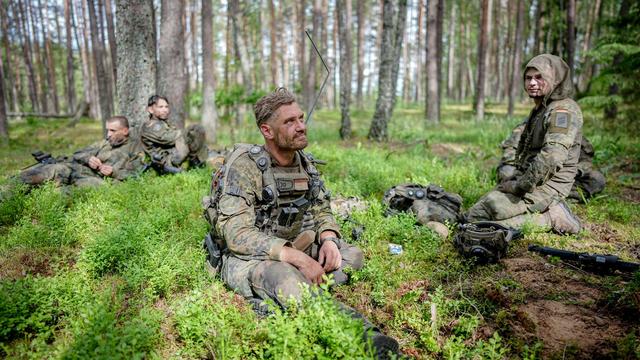
Battle exercise in Lithuania: 'In war, I would be dead now'
Translated from German, summarized and contextualized by DistantNews.
At a glance
News
Named sources
Ongoing story
- German Panzergrenadiers are participating in the "Freedom Shield 2026" exercise in Lithuania, practicing urban combat scenarios.
- The exercise involves approximately 2,900 soldiers, with 2,300 from Germany, focusing on new concepts for drone warfare and electronic combat.
- The Bundeswehr is using the exercise to test new strategies and equipment, aiming to improve its "warfighting capability" in response to potential threats along NATO's eastern flank.
German Panzergrenadiers are honing their urban combat skills in Lithuania as part of the "Freedom Shield 2026" exercise. The drills simulate intense battlefield conditions, where split-second decisions can mean the difference between life and death. Soldiers are pushed to their limits, practicing assaults through heavily fortified enemy positions, complete with mines, barbed wire, and barricades.
In the event of war, I would be dead now.
The exercise involves around 2,900 troops, the majority of whom, 2,300, are from Germany. This deployment marks the first time the Bundeswehr's new Panzerbrigade 45, nicknamed "Lithuania" due to its stationing for deterrence against Russia, is training on Lithuanian soil. The brigade is serving as a pilot project for achieving enhanced "warfighting capability."
Attack, attack, attack.
New concepts for fighting with and against drones are a central focus. Soldiers are practicing responses to simultaneous drone attacks and the deployment of unmanned systems for reconnaissance and offensive operations. Brigadier General Christoph Huber emphasized the need to acquire more small kamikaze drones, including FPV drones controlled via video goggles, a tactic proven effective in Ukraine. "What we can reconnoiter, we also want to be able to destroy directly," Huber stated.
In conjunction with the tanks, we Panzergrenadiers have enormous striking power.
Furthermore, the exercise incorporates advanced electronic warfare (EloKa) tactics. Specialists are setting up sensors and transmitters near the border with Belarus to intercept and analyze enemy military data, while also ensuring the security of their own communications and disrupting enemy systems. This high-tech aspect of the exercise underscores the evolving nature of modern warfare.
What we can reconnoiter, we also want to be able to destroy directly.
DistantNews Editorial
Originally published by Die Zeit in German. Translated, summarized, and contextualized by our editorial team with added local perspective. Read our editorial standards.
More Stories



From Our Blog

What Gets Lost (and Found) When News Is Translated

How the Same Story Looks Different in Different Countries

The Critical Role of Diaspora Media in Global News

What Travellers Should Know About Countries with Restricted Press

A Digital Nomad's Guide to Following Local News
