

Bavaria Celebrates Corpus Christi with Splendor Amidst Church Crisis
Translated from German, summarized and contextualized by DistantNews.
At a glance
News
From a news agency
Context piece
- Catholic churches in Bavaria are preparing for Corpus Christi processions with elaborate displays despite facing church membership decline and reform debates.
- Corpus Christi, a feast since the 13th century, involves processions centered around the monstrance, carrying the Host.
- In Nuremberg, an unusual ecumenical approach sees the celebration begin in an evangelical church, highlighting a shift in religious demographics.
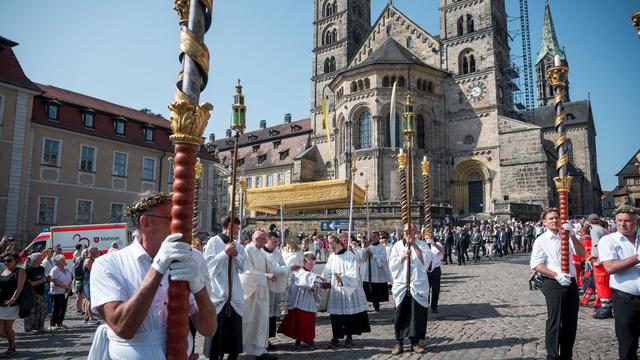
Despite facing declining membership, reform debates, and personnel shortages, the Catholic Church in Bavaria is preparing to showcase its splendor and tradition during the upcoming Corpus Christi holiday. Elaborate processions featuring incense, altar servers, holy figures, banners, and abundant flowers are planned to evoke the baroque grandeur of past eras.
Corpus Christi, officially the "High Feast of the Body and Blood of Christ," has been a celebrated feast since the 13th century, officially established by Pope Urban IV in 1264. The tradition of processions, with the monstrance, a precious reliquary containing the consecrated Host, at its center, has a long history in Bavaria, with the first known procession in the region occurring in 1286 in Benediktbeuern. Bamberg boasts a particularly long tradition, dating back to 1390. These processions often involve carrying heavy, ornate relics, such as the 600-kilogram Bamberg Cathedral Cross, requiring significant manpower.
In Munich, the procession will traditionally wind through the city center, preceded by a service led by Cardinal Reinhard Marx, the Archbishop of Munich and Freising, on Marienplatz. A unique ecumenical gesture will occur in Nuremberg, Bavaria's second-largest city. For the Corpus Christi celebration, the faithful will begin their day with a service held in the Protestant St. Sebald church, where city dean Andreas Lurz will preside. The procession will then proceed to the Catholic Frauenkirche. This interdenominational cooperation highlights the changing religious landscape in Nuremberg, a city that was predominantly Protestant after the Reformation in 1525. Currently, more than half of its residents are no longer members of either major Christian church, with Protestants slightly outnumbering Catholics.
Bavaria observes Corpus Christi as a public holiday. In Munich, as of December 31, 2025, 22.8 percent of the city's population were members of the Catholic Church, while 8.3 percent were Protestant, according to city data.
DistantNews Editorial
Originally published by Die Zeit in German. Translated, summarized, and contextualized by our editorial team with added local perspective. Read our editorial standards.
More Stories



From Our Blog

What Gets Lost (and Found) When News Is Translated

How the Same Story Looks Different in Different Countries

The Critical Role of Diaspora Media in Global News

What Travellers Should Know About Countries with Restricted Press

A Digital Nomad's Guide to Following Local News
