

Beethoven's Ninth Symphony resonates with themes of fraternity amid global division
Translated from Spanish, summarized and contextualized by DistantNews.
At a glance
News
Named sources
Context piece
- Conductor Alondra de la Parra presented Beethoven's Ninth Symphony, highlighting its message of fraternity amidst global turmoil.
- She drew parallels between Beethoven's era of war and division and the present day.
- The performance aimed to inspire hope and unity, emphasizing the power of choice in creating a better world.
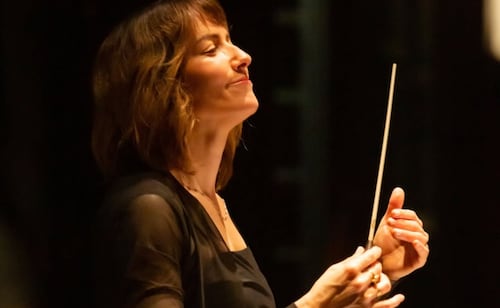
Orchestra conductor Alondra de la Parra presented Beethoven's Ninth Symphony as a powerful call for fraternity, drawing parallels between the composer's era and the current fractured world. "This night we gather to seek harmony within a fractured world because it is truly fractured, in the same way it was at the time Beethoven composed this symphony," de la Parra stated, noting that Europe in 1824 was marked by war and deep political distrust.
This night we gather to seek harmony within a fractured world because it is truly fractured, in the same way it was at the time Beethoven composed this symphony. When he composed it, in 1824, Europe was marked by a war and deeply divided by political distrust.
De la Parra observed that humanity seems to have learned little in 200 years. She presented the "Voices of Fraternity" concert, leading dozens of top-tier artists including singers Serena Sáenz, Gaëlle Arquez, Arturo Chacón-Cruz, and Gianluca Margheri, along with La Orquesta Imposible and the Orquesta y Coro de la Comunidad de Madrid. The performance featured Beethoven's "Symphony No. 9 in D minor, Op. 125, Coral."
Almost 200 years and we are still with the same question. On a personal level, Beethoven suffered profound isolation because he was completely deaf, fighting against that loneliness and physical deterioration. Within this situation, one would have thought Beethoven would have written a work full of despair, and yet he made another decision. And it is what I invite you to think about today: it is a decision that changes the world. The decision was to make an optimistic work that called for fraternity, a call to fraternity as a decision, as an option.
Reflecting on Beethoven's personal struggles with deafness and isolation, de la Parra noted the composer's decision to create an optimistic work calling for brotherhood. "Almost 200 years and we are still with the same question. On a personal level, Beethoven suffered profound isolation because he was completely deaf, fighting against that loneliness and physical deterioration. Within this situation, one would have thought Beethoven would have written a work full of despair, and yet he made another decision. And it is what I invite you to think about today: it is a decision that changes the world. The decision was to make an optimistic work that called for fraternity, a call to fraternity as a decision, as an option," she explained.
It is necessary for life. It is a very complicated role. Beethoven did not have the experience of writing for voices. It is the general comment among colleagues of various generations: Beethoven wrote something very difficult for the voice.
She detailed how each movement of the Ninth Symphony broke new ground, from the opening reflecting ideological conflict to the energetic scherzo of the second movement. The inclusion of singers, unusual for a symphony not an opera or requiem, added conceptual cohesion. Tenor Arturo Chacón-Cruz described the Ninth as a challenging but essential work, noting Beethoven's difficulty in writing for voices, yet ultimately creating an "anthem to unity."
The public does not realize it, but the choir is singing very finely, but the result is incredible: a vibration, a mass of voices that arrive together with the orchestra that finally arrive at an anthem to unity.
DistantNews Editorial
Originally published by El Universal in Spanish. Translated, summarized, and contextualized by our editorial team with added local perspective. Read our editorial standards.
More Stories

From Our Blog

What Press Freedom Means for the News You Read

What Gets Lost (and Found) When News Is Translated

The Critical Role of Diaspora Media in Global News

What Travellers Should Know About Countries with Restricted Press

A Digital Nomad's Guide to Following Local News
