


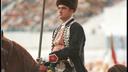
Behind the Sinjska Alka champions: The years of work and skilled riders who create the heroes
Translated from Croatian, summarized and contextualized by DistantNews.
At a glance
In-depth
Sources not specified
Context piece
- The Sinjska Alka knightly game commemorates the 1715 defense of Sinj against the Ottomans.
- Historically, only men born in Sinj could compete, but this rule was eventually abolished after a controversial inclusion.
- The article highlights the dedication and skill of the participants, many of whom are also accomplished equestrian athletes.
The Sinjska Alka, a traditional knightly game held annually in early August, commemorates the heroic defense of the town of Sinj against Ottoman forces in 1715, aided by the Miraculous Lady of Sinj. The event features knights wielding lances, their attendants, musicians, and a ceremonial procession led by the Alka Duke.
Historically, participation in the Alka was restricted to men born in Sinj, or those born in Split due to birth complications. However, this tradition was challenged and eventually altered. A notable instance involved Mario Šušnjara, who was included in the Alka company by then-Alka Duke General Mirko Norac, based on a misunderstanding that Šušnjara was born in Sinj, when in fact he was born in Šibenik. This event led to a series of statutory violations, ultimately resulting in the deletion of the birth location requirement from the statutes of the Knights' Alka Society.
For years, alkar Šušnjara showed exceptional quality. Besides winning the Bare and Choja, he also won two Alkas, in 2003 and 2010.
Despite the controversy surrounding his inclusion, Šušnjara demonstrated exceptional skill, winning the Alka twice in 2003 and 2010. His dedication to the Alka led him to relocate to Trilj and he completed his secondary education in Sinj. Šušnjara also excelled in show jumping, a discipline that has a strong connection to the Alka.
The article also points to the significant talent pool of elite riders and competitors who are associated with the Alka, many of whom also achieve success in show jumping. This group includes multiple national champions and representatives, such as Ante Šimleša, Denis Gugić, Andrija Hrgović, and Josip Gugić. These individuals, through their extensive training and competitive experience, contribute to the high standard of the Sinjska Alka, showcasing a blend of historical tradition and modern equestrian prowess.
Through his school passed almost all the alkars, while only a smaller part, less than seven percent, independently mastered the basics of riding from 1968 to today.
DistantNews Editorial
Originally published by Večernji List in Croatian. Translated, summarized, and contextualized by our editorial team with added local perspective. Read our editorial standards.
More Stories



From Our Blog

What Gets Lost (and Found) When News Is Translated

The Critical Role of Diaspora Media in Global News

What Travellers Should Know About Countries with Restricted Press

A Digital Nomad's Guide to Following Local News

How the Same Story Looks Different in Different Countries
