


Beyond flying taxis: China’s low-altitude economy targets practical uses, including emergency response
Summarized and contextualized by DistantNews.
At a glance
News
Sources not specified
Context piece
- China's low-altitude aviation industry is focusing on practical applications like emergency response and cargo transport, moving beyond passenger air taxis.
- Companies are developing specialized aircraft, such as eVTOLs with enclosed fans for urban safety and drones with robotic arms for dangerous tasks.
- While air taxi development continues, the industry sees near-term commercial viability in these real-world applications, with some services potentially launching next year.
China's burgeoning low-altitude aviation industry is charting a course beyond the futuristic vision of passenger air taxis, prioritizing practical applications that promise immediate real-world impact. Developers are increasingly focusing on uses ranging from emergency rescue and firefighting to efficient cargo transport and building maintenance, showcasing these ambitions at events like Shanghai's International Advanced Air Mobility Expo.
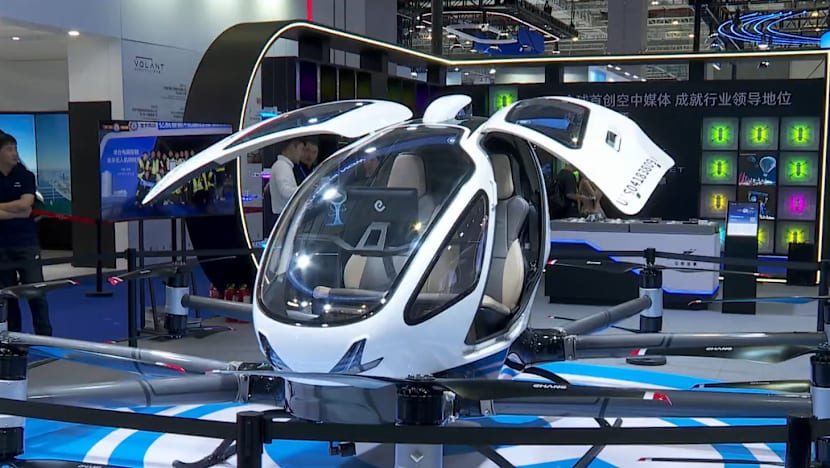
While autonomous passenger aircraft like EHang's EH216-S, which has received significant regulatory approval, are part of the landscape, many exhibitors are looking to specialized applications for quicker commercial viability. E-Hawk Technology, for instance, has unveiled an electric vertical take-off and landing (eVTOL) aircraft designed with enclosed ducted fans. CEO Henry Cai highlights this design as "much safer, quieter and more urban-friendly," requiring only a tenth of the space of a traditional helicopter for takeoff and landing.
Within three years, some cities could first introduce demonstration services, with perhaps three (to) around 10 fixed flight routes.
E-Hawk believes these specialized applications could become commercially viable as early as next year. Potential uses include emergency rescue operations, such as extracting individuals from burning buildings, transporting cargo between ships and the shore, and offering low-altitude tourism as an alternative to helicopters. The company's drones are also being developed with features like robotic arms for tasks such as window cleaning or retrieving objects, and can be equipped with tools for more efficient high-rise fire suppression.
Beyond the aircraft themselves, the expo highlighted practical innovations demonstrating how these flying machines can integrate into daily life and industry. Shenzhen-based Damoda showcased a drone light show system capable of deploying over 500 drones rapidly. These advancements suggest that while the dream of widespread air taxi services may take time, the immediate future of China's low-altitude economy lies in its ability to solve pressing practical challenges.
The takeoff and landing space is only one-tenth of the space that a traditional helicopter could take. You can take off from your parking lot or rooftop.
DistantNews Editorial
Originally published by CNA. Summarized and contextualized by our editorial team with added local perspective. Read our editorial standards.
More Stories


From Our Blog

What Gets Lost (and Found) When News Is Translated

The Critical Role of Diaspora Media in Global News

What Travellers Should Know About Countries with Restricted Press

A Digital Nomad's Guide to Following Local News

How the Same Story Looks Different in Different Countries
