



Bhotekoshi floods expose gaps in Nepal’s emergency communications
Summarized by DistantNews. Read the original for the full story.
At a glance
News
Named sources
Ongoing story
- Flooding across Nepal’s Bhotekoshi river system damaged 83 Nepal Telecom towers and 27 Ncell sites in Rasuwa, Nuwakot and Dhading.
- Operators have restored most services, but residents and regulators report dropped calls, congestion and poor audio quality where backup towers carry traffic.
- Ncell estimates direct physical losses above 90 million Nepali rupees, while Prime Minister Balendra Shah told parliament that 95% of services had been restored.
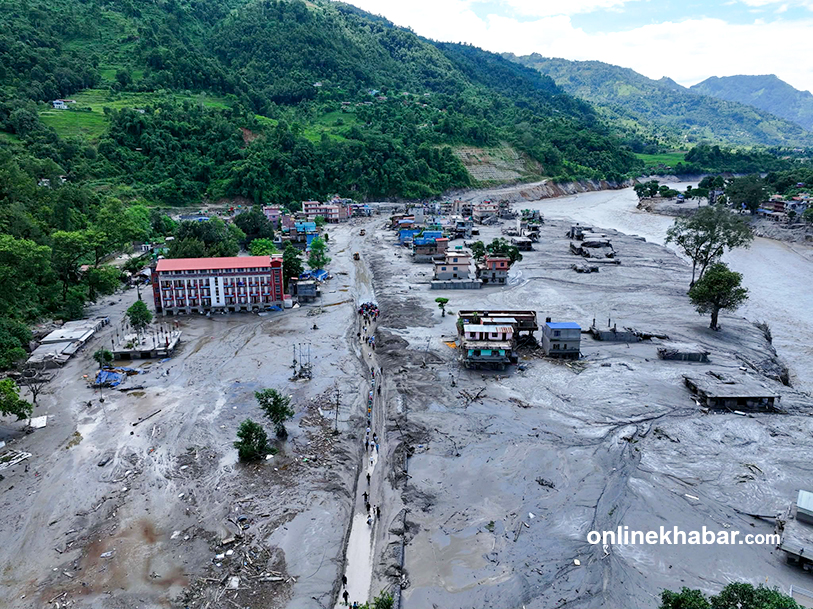
The floods that swept through Nepal’s Bhotekoshi river system last Wednesday left more than damaged roads and buildings behind. They also exposed how quickly emergency communications can fail when towers and fiber links are destroyed.
Telecommunications infrastructure suffered heavy damage in Rasuwa, Nuwakot and Dhading. Nepal Telecom reported major damage to 83 mobile towers, while private operator Ncell said 27 of its sites were affected. Both companies have restored most services, but a working signal has not always meant a usable connection for people in the disaster zone.
Priority will be given to rebuilding towers that were completely destroyed.
Residents describe calls that take several attempts to connect, break up midway or become so distorted that the speakers cannot understand each other. “In one or two attempts, the call connects, but you can’t hear what the other person is saying. You can hear the flood-like ringing sound instead,” said Ramhari Prasad Bhatta, a resident of Jiling in Nuwakot. He also reported crackling during calls and messages saying that a phone was switched off.
Nepal Telecom said it had returned all flood-affected sites to operation. Where towers were washed away, including sites at Timure, Chilime Khola and Trishuli 3A, it used nearby alternative sites to provide coverage. “Priority will be given to rebuilding towers that were completely destroyed,” said Kamal Lamichhane, a spokesperson for Nepal Telecom.
Ncell said 24 of its 27 affected sites had been restored. Three destroyed sites, at Trishuli in Nuwakot and Tiru and Timure in Rasuwa, remain difficult to rebuild. At Tiru, the lack of road access means equipment must be flown in by helicopter. At Trishuli, Ncell is using a ropeway across the river to transport equipment and carry out reconstruction.
In one or two attempts, the call connects, but you can’t hear what the other person is saying. You can hear the flood-like ringing sound instead.
The financial damage is also substantial. At Timure, a Ncell tower and more than 60 kilometers of optical fiber were washed away, causing preliminary direct physical losses of more than 90 million Nepali rupees. Nepal Telecom lost three sites entirely and has not yet calculated its full losses.
The Nepal Telecommunications Authority has received complaints similar to those from residents. “In some places, services are being provided through alternative towers, so congestion or heavy traffic may be causing occasional quality problems,” said Min Prasad Aryal, the authority’s spokesperson. The disruption has renewed calls to implement a disaster communications plan drafted after the 2015 earthquake.
In some places, services are being provided through alternative towers, so congestion or heavy traffic may be causing occasional quality problems.
About this summary
Originally published by Kathmandu Post. Summarized and contextualized automatically by DistantNews, with a note on how the source frames the story. Not individually reviewed before publishing. How this works.
More Stories


From Our Blog

News in Translation: What Gets Lost, and How We Keep the Framing

Diaspora Media: How Communities Abroad Follow Home

Traveling Where the Press Is Not Free: How to Read the News There

The Digital Nomad's Guide to Local News

The Same Story, Different Countries: How Coverage Changes at the Border
