


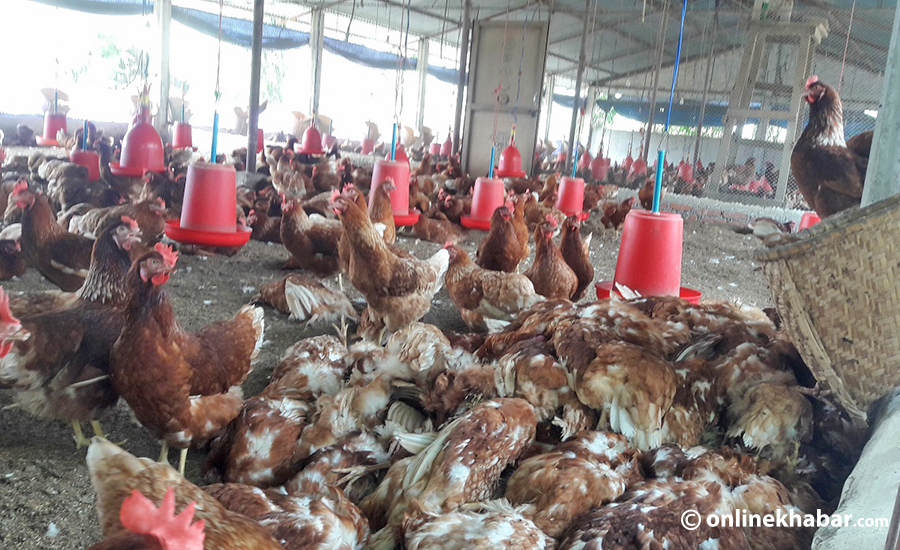
Bird Flu Cases Rise Sharply in Nepal, Over Half a Million Birds Culled
Translated from English, summarized and contextualized by DistantNews.
At a glance
News
Official statement
Context piece
- Bird flu infections are increasing in Nepal, with cases confirmed in 82 locations across 11 districts, particularly in the Kathmandu Valley.
- Since March, the Department of Livestock Services has culled nearly 570,000 birds and destroyed over 989,000 eggs to control the H-5N-1 outbreak.
- While the disease is reportedly under control in some eastern and southern districts, vigilance remains high in the Kathmandu Valley, and genetic sequencing is underway to monitor the virus.
Bird flu cases are escalating across Nepal, with infections now confirmed in 82 locations spanning eleven districts, posing a growing concern, especially within the Kathmandu Valley. The Department of Livestock Services reports that the H-5N-1 strain has spread rapidly over the past three months.
To curb the outbreak, authorities have implemented stringent measures. Since March, a total of 569,858 birds have been culled, alongside the destruction of 989,313 eggs and significant quantities of feed. The Department has established a dedicated Bird Flu Disease Control Room and deployed technical teams to collaborate with various levels of government in affected areas.
so far, a total of 569,858 birds have been culled to manage the outbreak. Additionally, 989,313 eggs and 1,954.85 quintals of feed have also been destroyed.
While the situation has reportedly been brought under control in several districts, including Morang, Jhapa, Sunsari, Mahottari, Bara, Chitwan, and Nawalparasi, the threat persists in parts of the Kathmandu Valley. Dr. Umesh Dahal, Director General of the Department, emphasized the need for continued vigilance in Kathmandu, Lalitpur, Bhaktapur, and Kavrepalanchok districts where the virus remains active.
In an effort to understand potential changes in the virus, the Department is collaborating with the National Public Health Laboratory to conduct gene sequencing. This aims to detect any genetic mutations in the infected H-5N-1 strain, providing crucial information for ongoing control efforts.
vigilance remains high in parts of Kathmandu, Lalitpur, Bhaktapur, and Kavrepalanchok, where the infection is still present.
DistantNews Editorial
Originally published by OnlineKhabar English in English. Translated, summarized, and contextualized by our editorial team with added local perspective. Read our editorial standards.
More Stories


From Our Blog

What Gets Lost (and Found) When News Is Translated

The Critical Role of Diaspora Media in Global News

What Travellers Should Know About Countries with Restricted Press

A Digital Nomad's Guide to Following Local News

How the Same Story Looks Different in Different Countries
