


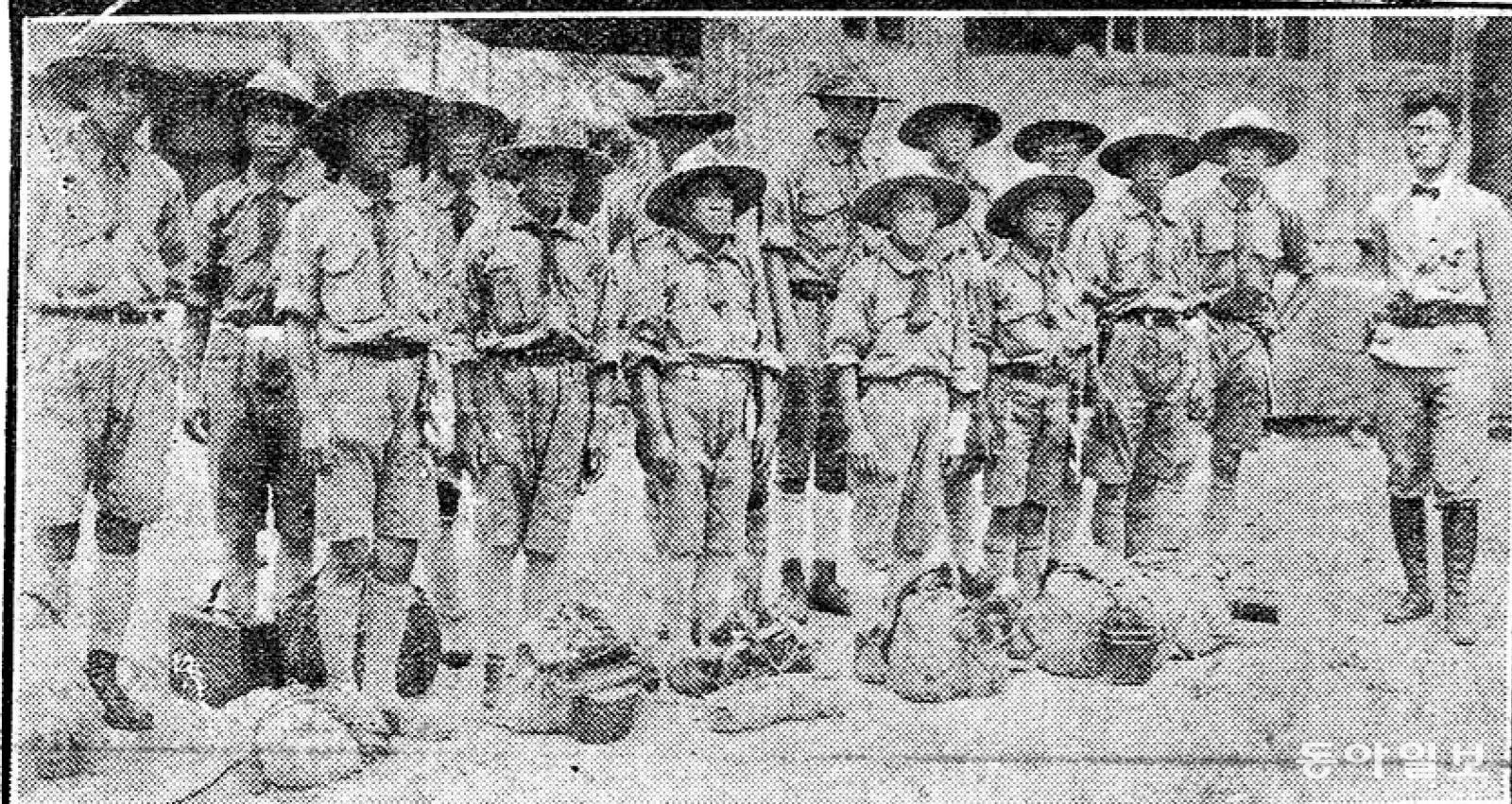
Boys carried tents to Geumgangsan instead of cram school during vacation
Translated from Korean, summarized and contextualized by DistantNews.
At a glance
In-depth
Sources not specified
Context piece
- Fifteen boys from Incheon embarked on a 2-week camping trip to Geumgangsan (Diamond Mountains) during their summer vacation in 1926.
- The trip, organized like a Boy Scout expedition, involved hiking and camping in tents, a stark contrast to modern summer activities.
- The article reflects on how Geumgangsan was a popular destination then, with various groups organizing tours, and contrasts it with the current inaccessibility of the region.
In the summer of 1926, while many children today seek refuge in air-conditioned rooms or attend cram schools, fifteen boys from Incheon embarked on an adventurous journey. They carried tents and luggage on their shoulders, heading to the scenic Geumgangsan, known as the "mysterious scenery of Joseon." This expedition, organized by the Incheon Boys' Corps, aimed to train their minds and bodies.
Incheon Boys' Corps set off to explore Geumgangsan, seeking to train their minds and bodies.
The boys, uniformed and equipped with wide-brimmed hats, set off from Sangincheon Station by train. Their itinerary included traversing various locations like Cheolwon, Sambang, Seokwangsa, Wonsan, Jangjeon, and Goseong, before exploring the Geumgangsan area. Unlike modern travelers who might stay in hotels or mountain lodges, these boys spent two weeks camping in tents in the mountains and fields, a true wilderness experience.
Their journey, initially planned for three weeks, concluded after about two weeks. A brief report in the Dong-A Ilbo on August 14th confirmed their safe return to Sangincheon Station. Their adventure covered significant ground, including Haegumgang, Naegeumgang, Wonsan, Seokwangsa, and Sambang.
They slept in tents in the mountains and fields.
Geumgangsan was a popular destination that summer, attracting people from all over. Advertisements and organized tours from Busan and Honam regions show that the mountains were bustling with visitors. A trip from Busan cost 45 won, a considerable sum at the time, equivalent to buying 450 monthly magazines or paying a month's school tuition. This suggests the Incheon boys' trek, involving walking and camping, was perhaps the most intrepid and economical way to experience Geumgangsan.
The 45 won fee was not a trip anyone could easily afford.
Eighty years later, the journalist visited Ondeong-ri, a place mentioned in the boys' journey, for a different purpose. While the boys could reach Geumgangsan by train, albeit with transfers, the region is now inaccessible. The article concludes by evoking the image of the boys' determined steps, carrying their loads and traversing mountain paths, a poignant contrast to the present.
The two weeks the Incheon boys spent trekking to Geumgangsan carrying tents might have been the most spirited way to spend the summer vacation and the most economical way to visit Geumgangsan.
DistantNews Editorial
Originally published by Dong-A Ilbo in Korean. Translated, summarized, and contextualized by our editorial team with added local perspective. Read our editorial standards.
More Stories



From Our Blog

What Gets Lost (and Found) When News Is Translated

The Critical Role of Diaspora Media in Global News

What Travellers Should Know About Countries with Restricted Press

A Digital Nomad's Guide to Following Local News

How the Same Story Looks Different in Different Countries
