

/nginx/o/2026/06/09/17702101t1hcd68.jpg)
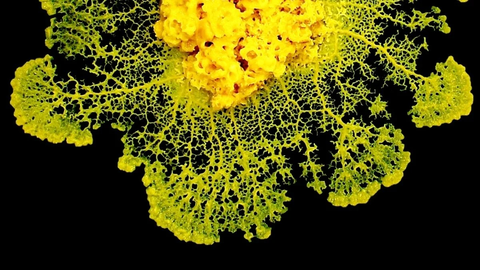
Brainless Slime Molds Make Smart Decisions, New Study Reveals
Translated from Estonian, summarized and contextualized by DistantNews.
At a glance
In-depth
Sources not specified
Context piece
- Slime molds, despite lacking brains, exhibit surprising intelligence in finding paths and adapting to environments.
- New research suggests their movement and internal processes are interconnected, explaining their complex behavior.
- Scientists are exploring whether this behavior stems from physics or something more.
Slime molds, often perceived as simple blobs of slime, are baffling scientists with their sophisticated decision-making abilities, all without possessing a brain.
These organisms demonstrate remarkable skills in navigating complex environments and adapting to changing conditions. This has led researchers to question how such seemingly basic life forms can exhibit intelligent behavior. A recent study offers a compelling explanation, proposing that the slime mold's movement and its internal biological processes are intrinsically linked, forming a unified system that drives its actions.
The findings suggest that the slime mold's ability to find efficient routes to food sources, for instance, is not a random occurrence but a result of this integrated system. Researchers are now delving deeper into the underlying mechanisms, investigating whether these complex behaviors are purely a product of physical laws or if there are more intricate biological factors at play.
This research challenges conventional notions of intelligence and consciousness, suggesting that complex problem-solving capabilities might emerge from simpler biological structures than previously thought. The study opens new avenues for understanding biological computation and the fundamental principles governing life's adaptability.
DistantNews Editorial
Originally published by Postimees in Estonian. Translated, summarized, and contextualized by our editorial team with added local perspective. Read our editorial standards.
More Stories
/nginx/o/2026/06/12/17711322t1h2e2a.jpg)
/nginx/o/2026/06/12/17710242t1h2b6f.jpg)
/nginx/o/2026/04/17/17567958t1h0512.jpg)
From Our Blog

What Gets Lost (and Found) When News Is Translated

The Critical Role of Diaspora Media in Global News

What Travellers Should Know About Countries with Restricted Press

A Digital Nomad's Guide to Following Local News

How the Same Story Looks Different in Different Countries
