


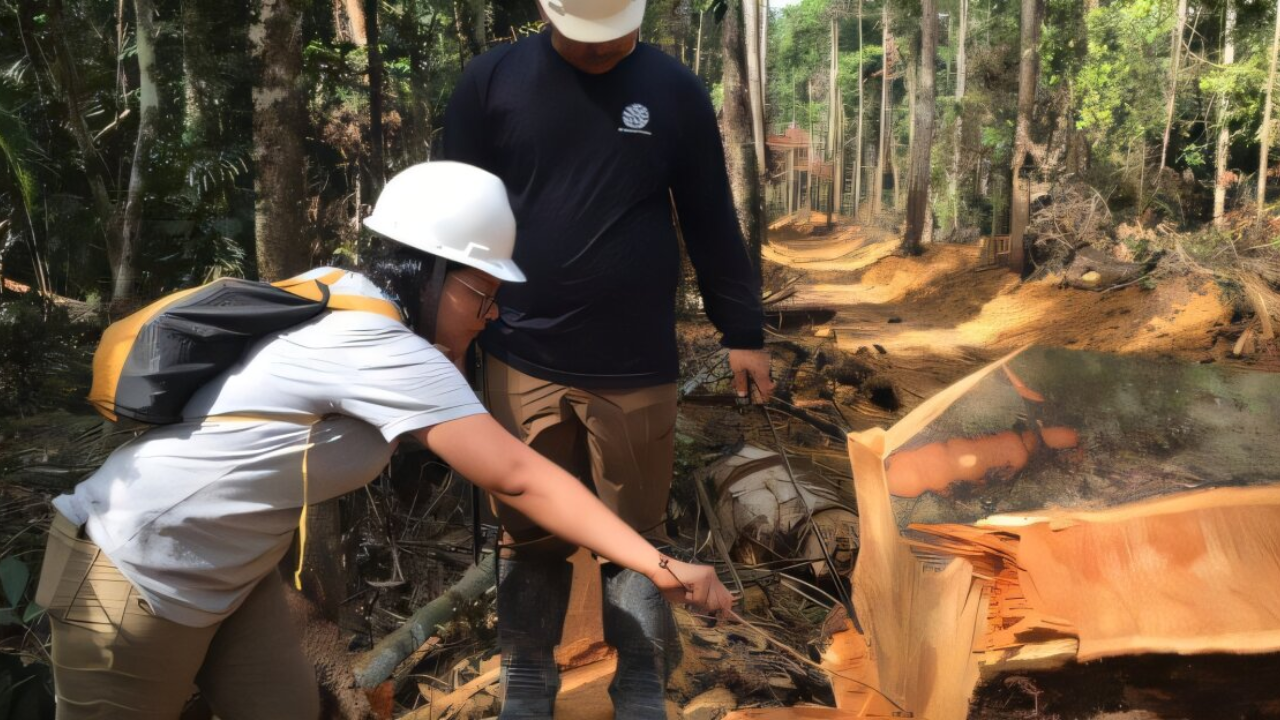
Brazilian scientists sampled 800 trees across 63 Amazon locations; their atomic fingerprinting...
Summarized and contextualized by DistantNews.
At a glance
News
Named sources
Context piece
- Brazilian scientists developed an isotopic mapping model to trace illegal timber, ruling out 92% of the Amazon rainforest.
- The model uses stable isotope analysis of oxygen in tree cellulose to create a forensic tool for law enforcement.
- Researchers aim to provide a tamperproof method to combat illegal logging, a major cause of deforestation, though further isotopes are needed for greater accuracy.
Brazilian researchers have created an isotopic mapping model capable of identifying the origin of timber, effectively ruling out 92% of the Amazon rainforest when tracing suspected illegal logging activities. The breakthrough uses atomic signatures from wood samples.
Led by Professor Luiz Antonio Martinelli at the University of São Paulo's Center for Nuclear Energy in Agriculture (CENA-USP), the project analyzes stable isotopes in tree cellulose. This method provides Brazil's Federal Police with a chemical fingerprinting technique designed to be forgery-proof, countering loggers' attempts to falsify harvesting permits.
The team's findings, published in the journal Molecules, focus on the ratio of oxygen-18 to oxygen-16 isotopes. This ratio varies across the Amazon based on rainfall patterns, creating a unique isotopic signature in tree wood. As moist air travels inland from the Atlantic, it loses heavier oxygen-18, resulting in rain with more oxygen-16 in the western Amazon. Trees absorb this water, embedding a lasting signature.
"Our goal is to provide the Federal Police with a tamperproof method. You can't falsify stable isotopes," Martinelli stated. He envisions the mapping tool, known as an isoscape, becoming usable by investigators without specialized training outside research labs once complete.
While the model significantly narrows the search area, excluding 3 million square kilometers, researchers acknowledge its limitations. The vastness of the Amazon means the remaining 8% is still substantial. Furthermore, accuracy decreases in the heavily deforested "deforestation arc." To enhance precision, PhD researcher Isabela Maria Souza Silva is incorporating carbon and nitrogen isotope data, with plans for strontium isotopes in the future.
Our goal is to provide the Federal Police with a tamperproof method. You can't falsify stable isotopes.
DistantNews Editorial
Originally published by Times of India. Summarized and contextualized by our editorial team with added local perspective. Read our editorial standards.
More Stories


From Our Blog

What Press Freedom Means for the News You Read

What Gets Lost (and Found) When News Is Translated

The Critical Role of Diaspora Media in Global News

What Travellers Should Know About Countries with Restricted Press

A Digital Nomad's Guide to Following Local News
