

British couple transforms derelict Victorian water tower into a family home
Translated from English, summarized and contextualized by DistantNews.
At a glance
In-depth
Named sources
Context piece
- A British couple transformed a derelict Victorian water tower into a family home.
- The seven-storey tower, built in 1877, was in severe disrepair before the multi-million-pound restoration.
- The project included adding a modern glass structure and a viewing room, while preserving the historic character.
A derelict Victorian water tower in South London, once supplying an asylum, has been reborn as a unique family home after a significant multi-million-pound restoration by a British couple. The Grade II-listed structure, built in 1877 to serve the Lambeth Workhouse and Infirmary, was acquired at auction by Leigh Osborne and Graham Voce.
An 85-foot Victorian water tower that once supplied an asylum in South London has been turned into a family home after a major multi-million-pound restoration by a British couple.
Upon purchasing the abandoned nine-storey landmark, the couple found it in a dire state. Trees had penetrated the brickwork, structural gaps were visible, and the interior was filled with rubbish and hundreds of dead pigeons. The building lacked utilities, and its masonry was up to six feet thick in places. Transforming this historic brick tower into a modern residence involved a complex restoration and construction project.
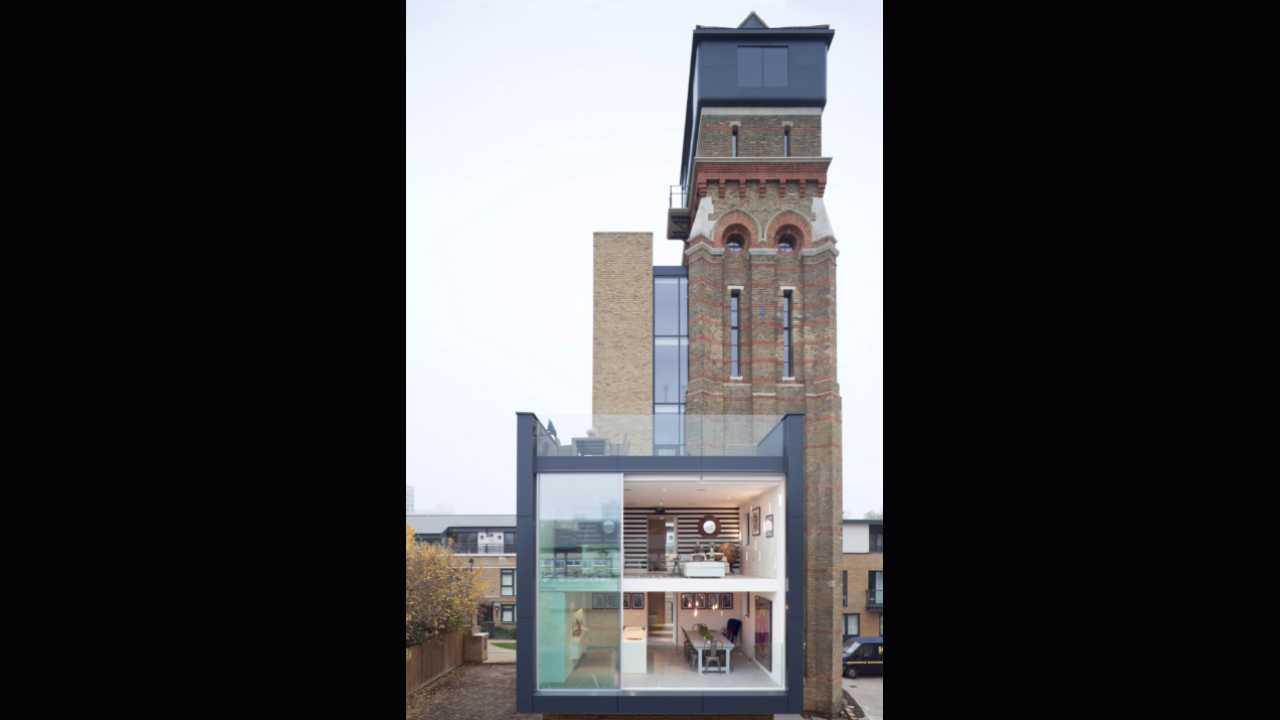
A striking addition is a four-storey glass structure at the tower's base, dubbed "the cube," which houses the main open-plan kitchen, dining, and living areas. A narrow secondary tower, containing a lift and bathrooms, was built alongside the original structure, connected by glazed corridors. At the very top, where a massive steel water tank once stood, the couple created a 360-degree glass viewing room offering panoramic views of central London, including landmarks like The Shard, Big Ben, and the London Eye.
When Osborne and Voce bought the property, the historic brick tower was in very poor condition.
The restoration faced significant practical and financial hurdles. The couple had a limited 12-month window to access neighboring land. Planning approvals, survey delays, and technical drawings compressed the actual construction period to just eight months. Costs escalated rapidly, with the glass alone costing £240,000 and scaffolding £60,000. Initial ground tests revealed deeper foundation work was needed, adding £25,000 within the first hour of site work. The finished home also required modern amenities, including a £25,000 air-source heat pump for heating and hot water, and a £35,000 integrated audio-visual system.
One of the biggest additions was a modern four-storey glass structure at the base of the tower, known as "the cube".
Despite the modern additions, the original 1877 water tower's historic character was meticulously preserved. Workers repaired the old brickwork while maintaining the building's original appearance. The tower also holds a link to social history, reportedly having been visited by Charlie Chaplin during his childhood stay at the nearby Lambeth Workhouse. The completed project has transformed a neglected piece of London's industrial and public infrastructure into a distinctive family home featuring four bedrooms and spacious living areas.
At the top of the 85-foot tower, where a huge steel water tank once stood, the couple built a 360-degree glass viewing room.
DistantNews Editorial
Originally published by Times of India in English. Translated, summarized, and contextualized by our editorial team with added local perspective. Read our editorial standards.
More Stories



From Our Blog

What Press Freedom Means for the News You Read

What Gets Lost (and Found) When News Is Translated

The Critical Role of Diaspora Media in Global News

What Travellers Should Know About Countries with Restricted Press

A Digital Nomad's Guide to Following Local News
