


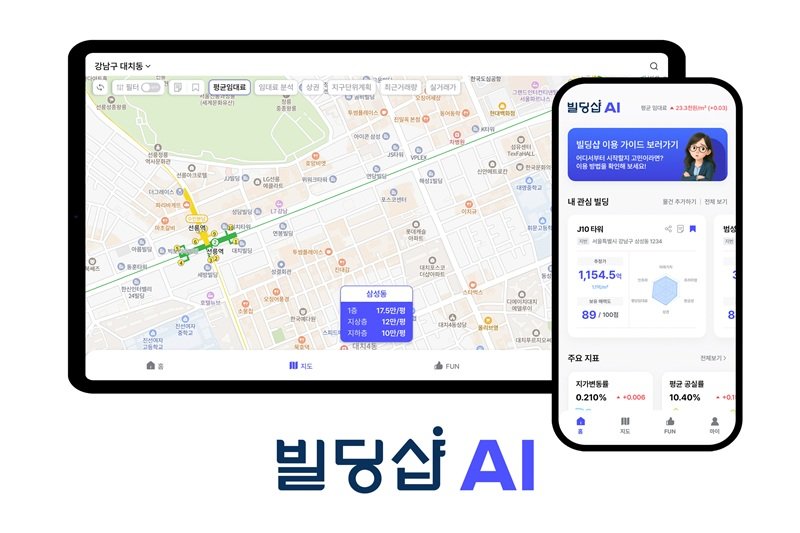
Building Value Assessment Using AI: Jeongin Real Estate Group Launches 'BuildingShop AI'
Translated from Korean, summarized and contextualized by DistantNews.
At a glance
News
Official statement
New plan
- Jeongin Real Estate Group has launched 'BuildingShop AI,' an AI-based valuation solution for commercial properties.
- Unlike existing services, BuildingShop AI focuses on providing future business potential data for value-up initiatives like remodeling or new construction.
- The platform analyzes property data, including building codes and market information, to offer current estimated values and future development potential reports.
Jeongin Real Estate Group, a comprehensive real estate services firm, has officially launched 'BuildingShop AI,' an artificial intelligence-powered solution designed to provide valuation benchmarks for commercial property investments. This new platform aims to offer investors a more forward-looking perspective on property value.
Distinguishing itself from current proptech services that primarily focus on past transaction data and property listings, BuildingShop AI emphasizes providing "future business potential estimation data." This data is intended to assist investors considering value-up strategies, such as renovations or new construction projects. The AI analyzes various factors to predict a property's future viability.
Users can input a property's address, and the AI will process extensive real estate big data, including relevant building codes, local commercial area data, and estimated construction costs. Based on this analysis, BuildingShop AI presents the building's current estimated value along with a report detailing its future development potential and estimated indicators.
The company anticipates that BuildingShop AI will serve as a crucial preliminary analysis tool for individual and institutional investors navigating the commercial building market, which is often characterized by information asymmetry. Park Jun-yeon, CEO of Jeongin Real Estate Group, stated that the platform aims to provide investors with more than just historical data.
DistantNews Editorial
Originally published by Dong-A Ilbo in Korean. Translated, summarized, and contextualized by our editorial team with added local perspective. Read our editorial standards.
More Stories



From Our Blog

What Gets Lost (and Found) When News Is Translated

The Critical Role of Diaspora Media in Global News

What Travellers Should Know About Countries with Restricted Press

A Digital Nomad's Guide to Following Local News

How the Same Story Looks Different in Different Countries
