


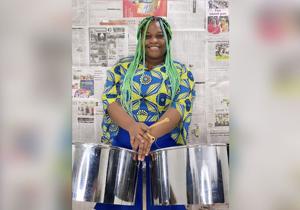
Call for disability inclusion in national arts events
Translated from English, summarized and contextualized by DistantNews.
At a glance
News
Named sources
Context piece
- Kharysa Gabriel, a pannist and music educator, advocates for a special-schools category in Junior Panorama and increased accessibility for people with disabilities in national arts events.
- Gabriel recently formed a steel orchestra for young people with various disabilities, who performed successfully after less than two weeks of practice.
- She aims to teach the group music reading and prepare them for SanFest 2027, demonstrating that inclusion and excellence can coexist.
Music educator Kharysa Gabriel is calling for greater inclusion in national arts events, specifically proposing a special-schools category for the Junior Panorama competition. Gabriel, who teaches at the National Centre for Persons with Disabilities (NCPD), believes such a change would make events more accessible for individuals with disabilities.
I love the idea of Special Olympics. I would like to see something like that in an artistic setting. Or maybe a category for special schools in Junior Panorama? I would like to open up the discussion more.
Gabriel recently established a steel orchestra comprised of young people with a range of disabilities, including autism, ADHD, and dyslexia. Despite none of the students having prior experience with the pan instrument, the group delivered a performance at an NCPD fundraiser after just two weeks of preparation. Gabriel expressed confidence in her students' abilities, stating, "From the very first rehearsal I knew I had a very gifted group."
From the very first rehearsal I knew I had a very gifted group. I never doubted their readiness.
Looking ahead, Gabriel plans to further develop the orchestra's skills by teaching them to read music and preparing them for the SanFest 2027 event. She sees this as an opportunity to prove that individuals with disabilities can achieve the same artistic standards as others with the right support. "It shows the public that inclusion and excellence can coexist," she said.
It would be proof that with the right support and opportunities, they can meet the same artistic standards as anyone else. It shows the public that inclusion and excellence can coexist.
Gabriel, who has prior experience teaching individuals with autism and performing with renowned steel orchestras, carefully selected students for different instruments. She focused on fostering a supportive learning environment, adapting her teaching methods to individual needs. For instance, she turned musical patterns into playful phrases to aid comprehension for students who responded well to verbal cues. She also emphasized the importance of small responsibilities outside of music, aiming to develop well-rounded individuals.
I believe in giving my students small responsibilities outside of learning music because I also want them to become responsible, all-rounded individuals.
DistantNews Editorial
Originally published by Trinidad Express in English. Translated, summarized, and contextualized by our editorial team with added local perspective. Read our editorial standards.
More Stories
From Our Blog

What Gets Lost (and Found) When News Is Translated

The Critical Role of Diaspora Media in Global News

What Travellers Should Know About Countries with Restricted Press

A Digital Nomad's Guide to Following Local News

How the Same Story Looks Different in Different Countries
