

Campaign Vehicles: Legal Loopholes and Public Nuisance in South Korea
Translated from Korean, summarized and contextualized by DistantNews.
At a glance
News
Sources not specified
Context piece
- South Korean election campaign vehicles face scrutiny over potential violations of traffic and noise regulations, despite being permitted under election law.
- While election law allows for campaigning via vehicles, specific actions like standing on moving vehicles or parking on sidewalks are illegal under separate laws.
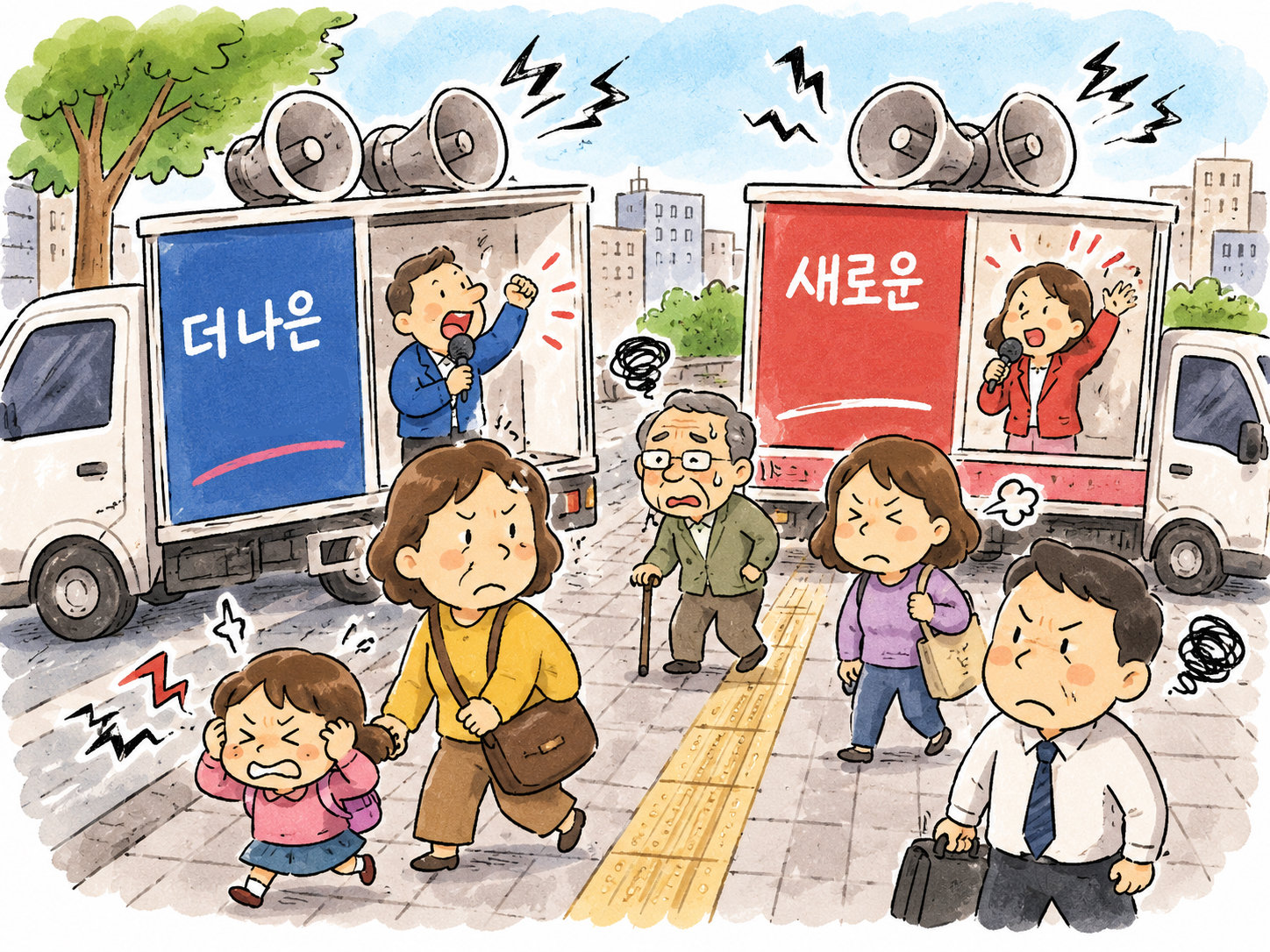
- Noise levels from campaign vehicle loudspeakers, though legally permitted up to 127dB, often exceed acceptable limits for residents, especially near sensitive areas like schools and hospitals.
As South Korea enters election season, campaign vehicles are becoming a focal point for public concern regarding potential legal infringements. While election laws permit extensive campaigning using vehicles and loudspeakers, these activities frequently clash with general traffic and noise regulations, creating a complex legal landscape.
One common issue involves candidates or campaigners standing on top of moving campaign vehicles. Although election law permits public speeches from vehicles, standing unsafely on a moving vehicle is a clear violation of the Road Traffic Act. Similarly, parking campaign vehicles on sidewalks, blocking pedestrian traffic, or obstructing intersections are illegal, just as they would be for any other vehicle.
The noise generated by campaign vehicles is another significant point of contention. While election law allows loudspeaker noise levels up to 127 decibels, considerably louder than a car horn and approaching the sound of a jet takeoff, this often causes distress to residents. Although specific time restrictions apply, with speeches generally limited between 7 a.m. and 11 p.m. (and loudspeaker use from 7 a.m. to 9 p.m.), the sheer volume can be disruptive, particularly near schools and hospitals.
Election officials primarily focus on enforcing election law violations, leaving the enforcement of traffic and noise regulations to other authorities. This division of responsibility means that while campaign activities might be legally permissible under one law, they can still constitute an offense under another, leading to public frustration and confusion.
In principle, you cannot carry people in the cargo area, but on a legally modified vehicle, campaigning while stationary is possible. However, standing and campaigning while the vehicle is moving is illegal.
DistantNews Editorial
Originally published by Dong-A Ilbo in Korean. Translated, summarized, and contextualized by our editorial team with added local perspective. Read our editorial standards.
More Stories


From Our Blog

What Gets Lost (and Found) When News Is Translated

The Critical Role of Diaspora Media in Global News

What Travellers Should Know About Countries with Restricted Press

A Digital Nomad's Guide to Following Local News

How the Same Story Looks Different in Different Countries
