


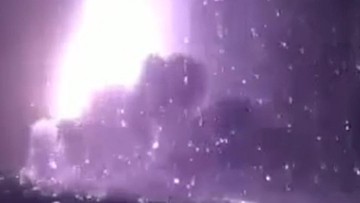

CCTV monitoring Anak Krakatau damaged after being hit by eruptive material
Translated from Indonesian and summarized by DistantNews. Read the original for the full story.
At a glance
News
Named sources
Ongoing story
- Anak Krakatau in South Lampung continued erupting after volcanic material damaged a monitoring CCTV camera.
- Authorities reported a lava fountain, explosions and rumbling, and warned people not to approach the volcano because further material could be ejected.
- The government said the risk of a tsunami is relatively low because the volcano’s rebuilt body remains small and is not currently considered likely to collapse at a scale that could trigger one.
A monitoring camera at Anak Krakatau stopped operating after volcanic material struck it during an eruption that began the previous night in South Lampung. The camera last captured activity at 1:01 a.m., when a lava fountain appeared.
The eruption continued from 11:07 p.m. on Friday into Saturday morning. People at the observation post in Pasauran heard explosions and rumbling. Authorities warned the public not to approach the volcano to watch the eruption or record images because the active crater could still eject material.
The field observation CCTV camera was reported to have stopped operating after being hit by volcanic material.
A report recorded one eruptive event with an amplitude of 70 millimeters and a reported duration of 21,600 seconds. The volcano was visible at times and obscured by varying levels of cloud, while no crater smoke was observed. Winds around the volcano were light to moderate and moved toward the northwest.
The explosions and rumbling heard from the Anak Krakatau Volcano Observation Post are part of the ongoing eruptive activity.
Authorities also addressed concerns among coastal residents in Banten and Lampung about a possible tsunami, particularly because of the tsunami linked to Anak Krakatau’s activity on Dec. 22, 2018. Berton SP Panjaitan of Indonesia’s disaster agency said an assessment by the Center for Volcanology and Geological Hazard Mitigation found that the volcano’s body, rebuilt after the 2018 eruption, remains relatively small and is not at risk of collapsing on a scale that could trigger a tsunami.
The center continues to monitor the volcano’s activity and changing shape. Officials urged residents to follow official information and recommendations and not draw their own conclusions from visible activity or rumbling sounds.
Based on the evaluation carried out by the Center for Volcanology and Geological Hazard Mitigation, the body of Anak Krakatau that regrew after the Dec. 22, 2018 eruption remains relatively small and is not at risk of collapsing on a scale that could trigger a tsunami.
About this summary
Originally published by CNN Indonesia in Indonesian. Translated, summarized, and contextualized automatically by DistantNews, with a note on how the source frames the story. Not individually reviewed before publishing. How this works.
More Stories

From Our Blog

News in Translation: What Gets Lost, and How We Keep the Framing

Diaspora Media: How Communities Follow News From Home

Traveling Where the Press Is Not Free: How to Read the News There

The Digital Nomad's Guide to Local News

The Same Story, Different Countries: How Coverage Changes at the Border
