


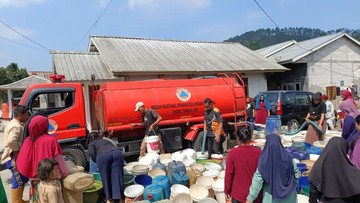
Central Java Distributes Over 3 Million Liters of Clean Water Amid Drought
Translated from Indonesian, summarized and contextualized by DistantNews.
At a glance
News
Sources not specified
Context piece
- Central Java Province has distributed over 3.2 million liters of clean water to more than 30,000 families affected by drought.
- The provincial government, in collaboration with local authorities and various agencies, is mapping drought-prone areas to provide tailored solutions.
- Measures include maintaining communal wells, improving water supply infrastructure, and promoting water conservation among residents.
Central Java Province has implemented measures to combat drought during the 2026 dry season, including the distribution of more than 3.2 million liters of clean water. Between June 5 and July 14, this aid reached 30,378 households, approximately 81,297 individuals, across 15 districts.
Governor Ahmad Luthfi stated that the provincial government, along with district heads and mayors, has mapped areas susceptible to clean water shortages. This mapping effort aims to guide subsequent actions, with the provincial government planning to execute interventions based on the data collected and in coordination with relevant departments. The handling of drought will be adjusted to the specific characteristics and needs of each region.
The district heads and mayors have already made a mapping. It has been mapped which areas are experiencing drought.
Several districts and cities in Central Java have already declared alert statuses for drought, including Sukoharjo, Demak, Temanggung, Brebes, Kendal, Sragen, Banjarnegara, Purbalingga, Grobogan, Semarang, Pemalang, Wonosobo, Purworejo, Wonogiri, Salatiga City, and Tegal City. The provincial government is also engaging in corporate social responsibility (CSR) activities through collaborations with local governments, BPJS Kesehatan, the Serayu Opak River Basin Center, and local water utility company Tirta Satria.
To bolster preparedness, the Central Java Provincial Government issued a circular letter on June 9 regarding anticipation of drought, forest, and land fires. This serves as a guideline for strengthening coordination and enhancing the readiness of all regional governments. Beyond immediate relief like clean water distribution, the province is focusing on medium and long-term strategies. These include maintaining communal boreholes, strengthening water supply infrastructure, improving logistics management, conserving water resources, and educating the public on wise water usage during the dry season.
The principle is, the district heads and mayors already have the data. We just need to execute the activities.
DistantNews Editorial
Originally published by CNN Indonesia in Indonesian. Translated, summarized, and contextualized by our editorial team with added local perspective. Read our editorial standards.
More Stories


From Our Blog

What Gets Lost (and Found) When News Is Translated

The Critical Role of Diaspora Media in Global News

What Travellers Should Know About Countries with Restricted Press

A Digital Nomad's Guide to Following Local News

How the Same Story Looks Different in Different Countries
