


 Image: INE
Chilean unemployment rises to 9.5% in May-July
Translated from Spanish and summarized by DistantNews. Read the original for the full story.
At a glance
News
Official statement
New plan
- Chilean unemployment rose to 9.5% in the May-July period, up 0.8 percentage points from the previous year.
- The increase stems from a growing labor force and a shrinking employed population.
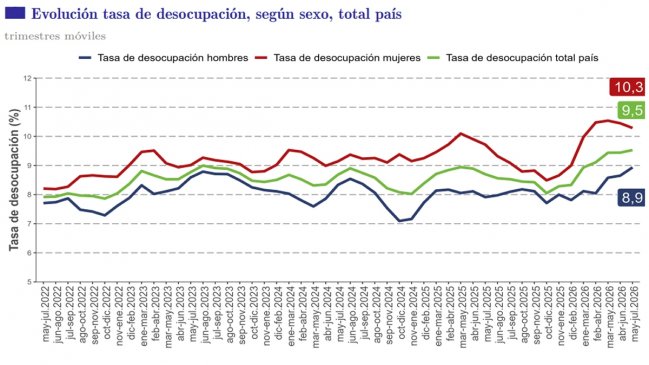
- Women's unemployment reached 10.3%, and men's was 8.9%, with the informal employment rate at 26.5%.
Chile's unemployment rate climbed to 9.5% in the three-month period from May to July, marking a significant increase of 0.8 percentage points compared to the same period last year. The National Statistics Institute (INE) reported that this rise is a result of a 0.7% expansion in the labor force coupled with a 0.2% reduction in the number of employed individuals.
The number of unemployed people surged by 10.4%. This increase was driven by those who had lost their jobs, up 9.4%, and a substantial 20.9% rise in individuals seeking work for the first time. The data highlights a growing challenge in the job market, affecting both experienced workers and new entrants.
Gender disparities persist in the unemployment figures. Among women, the unemployment rate stood at 10.3%, an increase of 0.6 percentage points over the year. For men, the rate was 8.9%, experiencing a more pronounced annual growth of 1.0 percentage point. Despite these figures, the INE noted that the total number of employed individuals decreased by 0.2% over the past 12 months, solely due to a 1.1% decline among men, as employment for women saw a 1% increase.
The rate of informal employment also saw a slight uptick, reaching 26.5%, an increase of 0.5 percentage points compared to the previous year. This suggests a growing reliance on informal work arrangements, which often come with less security and fewer benefits.
About this summary
Originally published by Cooperativa in Spanish. Translated, summarized, and contextualized automatically by DistantNews, with a note on how the source frames the story. Not individually reviewed before publishing. How this works.
More Stories


From Our Blog

What Gets Lost (and Found) When News Is Translated

The Critical Role of Diaspora Media in Global News

What Travellers Should Know About Countries with Restricted Press

A Digital Nomad's Guide to Following Local News

How the Same Story Looks Different in Different Countries
