


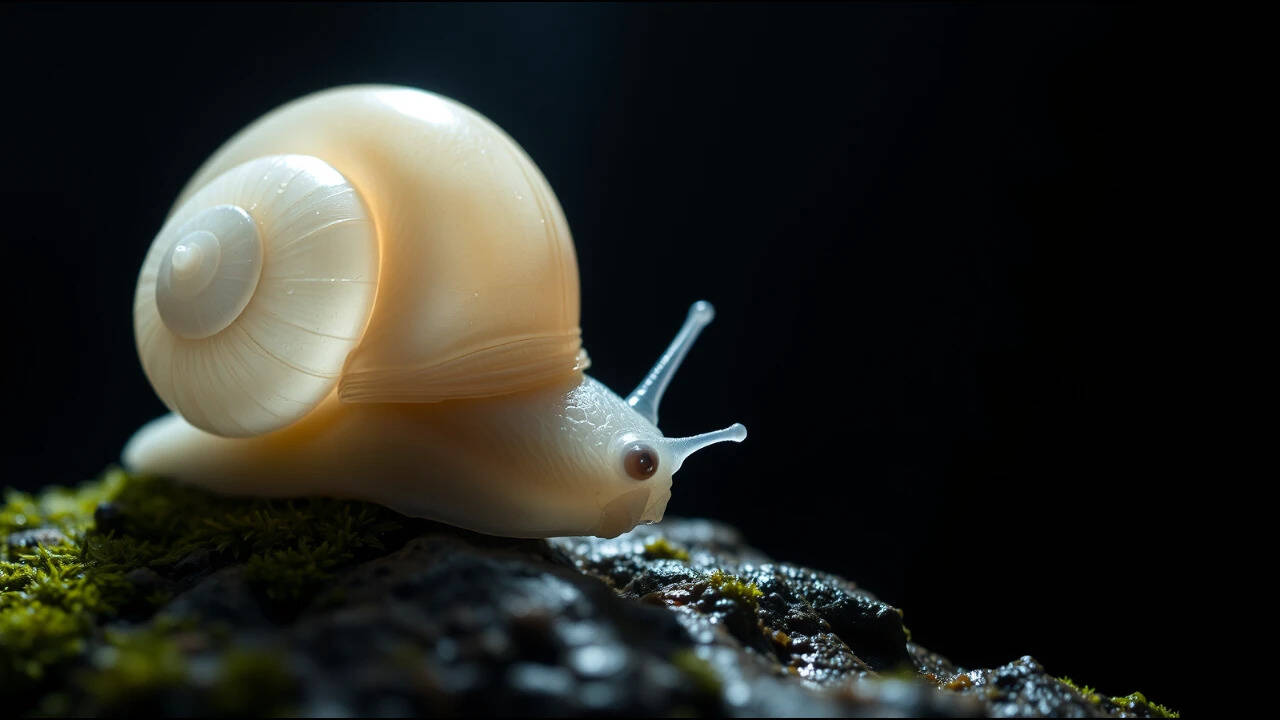
China discovers its first freshwater cave snail, a rare eyeless species
Translated from English, summarized and contextualized by DistantNews.
At a glance
News
Sources not specified
Context piece
- Scientists identified China's first known freshwater cave snail, named Erhaia dijiang, with only three living adults ever found.
- The eyeless, colorless snail adapted to permanent darkness deep inside a mountain cave in Yunnan Province, filling a gap in underground ecosystem studies.
- Its unique name references a faceless mountain god from ancient Chinese text, and its discovery extends the known range of its family to high altitudes.
Scientists have identified China's first known freshwater cave snail, a species so rare that only three living adults have ever been found. The tiny animal, named Erhaia dijiang, possesses no eyes and almost no body color, with a translucent shell revealing its delicate tissues.
Researchers discovered the snail deep within a mountain cave in Yunnan Province, a habitat devoid of sunlight where life has adapted to perpetual darkness. This species belongs to troglobionts, creatures exclusively adapted to cave life. Over countless generations, Erhaia dijiang lost its eyes and pigmentation, traits common among cave-dwelling species that have no need for vision or sun protection. In laboratory settings, the snails actively avoided light, seeking refuge in dark crevices.
Erhaia dijiang belongs to a group of animals called troglobionts, meaning it is built entirely for life inside caves and cannot survive elsewhere.
The snail's unusual appearance inspired its name. Erhaia dijiang is named after Di Jiang, a faceless mountain god from the ancient Chinese text "Classic of Mountains and Seas." The species is part of the Erhaiidae family, and its formal description was published in the journal "Subterranean Biology." The discovery also marks the highest elevation recorded for a cave-dwelling member of this family, suggesting that freshwater cave snails can thrive in high-altitude karst systems over 2,000 meters above sea level.
Erhaia dijiang is named after Di Jiang, a mountain god described in the ancient Chinese text Classic of Mountains and Seas as a faceless creature, a fitting match for an animal whose head shows no trace of eyes or a defined face.
DistantNews Editorial
Originally published by Times of India in English. Translated, summarized, and contextualized by our editorial team with added local perspective. Read our editorial standards.
More Stories



From Our Blog

What Press Freedom Means for the News You Read

What Gets Lost (and Found) When News Is Translated

The Critical Role of Diaspora Media in Global News

What Travellers Should Know About Countries with Restricted Press

A Digital Nomad's Guide to Following Local News
