

China opens first robot school, enrolling 30 robots
Translated from Korean, summarized and contextualized by DistantNews.
At a glance
News
Sources not specified
Context piece
- China has opened its first robot-specific school in Hangzhou, Zhejiang province, admitting 30 robots as its inaugural students.
- The school, a collaboration between Zhejiang University's robotics institute and industry partners, aims to bridge the gap between hardware capabilities and practical application skills for robots.
- The curriculum includes specialized training and evaluation for robots destined for industrial, service, security, and artistic roles, with a special track for 'companion robots' that can recognize emotions.
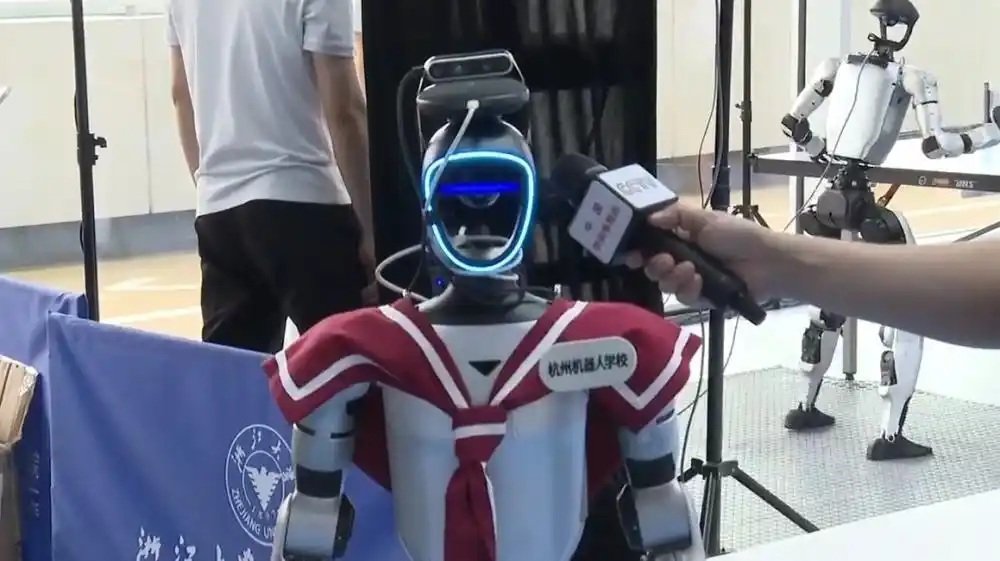
Hangzhou, China, has launched the nation's first school dedicated to robotics, welcoming 30 robots as its first "students." This pioneering institution, established through a joint effort by Zhejiang University's robotics institute, the Zhejiang Provincial Institute for Quality Science, and leading robotics companies, seeks to address a critical industry challenge: the gap between advanced robot hardware and the intelligent application skills needed for real-world deployment.
The 30 initial robot enrollees will undergo specialized job training, functional assessments, and certification processes. These robots are slated for deployment across various sectors, including industry, services, security, and the arts. Chinese media have highlighted the school's role as an industrial platform designed to refine robot prototypes to a level suitable for immediate field application and performance verification.
Zhejiang University has developed a 'logical brain' based on the 'VL2A' architecture, enabling robots to acquire specialized skills for specific jobs.
Zhu Sichang, head of the robotics institute at Zhejiang University, explained the school's approach. "Zhejiang University has developed a 'logical brain' based on the 'VL2A' architecture, enabling robots to acquire specialized skills for specific jobs," he stated. Zhu emphasized that the industry's current need is not just for mobile robots, but for those capable of understanding situations and making independent decisions to perform tasks.
The school also offers a "companion robot" training program. This curriculum focuses on enhancing robots' autonomous thinking and learning abilities by teaching them to recognize emotions and strengthen their memory functions. During a demonstration, a companion robot detected a person sighing on a sofa, responded with comforting words, and then attempted to lighten the mood with a joke, showcasing its developing emotional intelligence and interactive capabilities.
The industry's current need is not just for mobile robots, but for those capable of understanding situations and making independent decisions to perform tasks.
DistantNews Editorial
Originally published by Dong-A Ilbo in Korean. Translated, summarized, and contextualized by our editorial team with added local perspective. Read our editorial standards.
More Stories


From Our Blog

What Gets Lost (and Found) When News Is Translated

The Critical Role of Diaspora Media in Global News

What Travellers Should Know About Countries with Restricted Press

A Digital Nomad's Guide to Following Local News

How the Same Story Looks Different in Different Countries
