


China presence in WPS shifts from navy to coast guard
Translated from English, summarized and contextualized by DistantNews.
At a glance
News
Named sources
Context piece
- China is shifting its maritime presence in the West Philippine Sea from navy vessels to coast guard and research operations, according to the Philippine military.
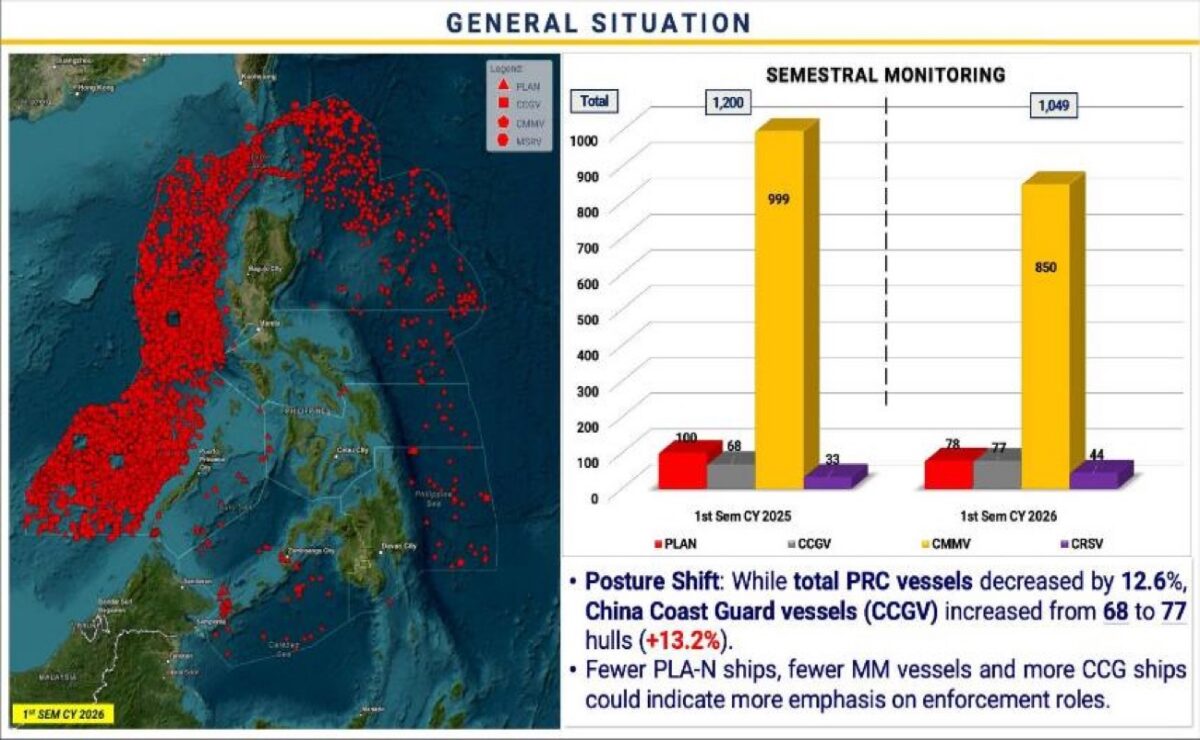
- The Philippine Navy monitored more China Coast Guard vessels and research ships in the first half of 2026 compared to the same period last year, while Chinese navy and maritime militia vessel numbers decreased.
- These deployment changes help the Philippine military strategize its own positioning of ships and aircraft in the disputed waters.
China appears to be altering its maritime strategy in the West Philippine Sea, with a notable increase in coast guard and research vessels while navy and militia ship numbers have declined, according to the Armed Forces of the Philippines (AFP).
In the first half of 2026, the Philippine Navy tracked 77 different China Coast Guard (CCG) vessels, an increase from 68 in the same period last year. Simultaneously, the number of Chinese navy vessels dropped to 78 from 100, and maritime militia vessels decreased from 999 to 850.
The AFP also observed a rise in Chinese research and survey ships, with 44 recorded compared to 33 the previous year. Of these, 16 exhibited "erratic tracks" suggesting survey activities across the West Philippine Sea, including key Philippine passages and Benham Rise.
During a specific week in August, the AFP documented 23 Chinese vessels in three key Philippine features: Ayungin Shoal, Panatag Shoal, and Pag-asa Island. These included 20 CCG ships, with 11 concentrated at Ayungin Shoal, where the Philippines maintains the BRP Sierra Madre as a military outpost.
While the AFP cannot pinpoint the exact cause for the reduction in Chinese navy and militia vessels, these deployment shifts are crucial for the military's strategic planning. "We monitor these numbers to give us an inclination of the direction that would help us project our deployment of forces," said AFP spokesperson for the WPS, retired Rear Adm. Roy Vincent Trinidad.
We monitor these numbers to give us an inclination of the direction that would help us project our deployment of forces.
DistantNews Editorial
Originally published by Philippine Daily Inquirer in English. Translated, summarized, and contextualized by our editorial team with added local perspective. Read our editorial standards.
More Stories


From Our Blog

What Gets Lost (and Found) When News Is Translated

The Critical Role of Diaspora Media in Global News

What Travellers Should Know About Countries with Restricted Press

A Digital Nomad's Guide to Following Local News

How the Same Story Looks Different in Different Countries
