


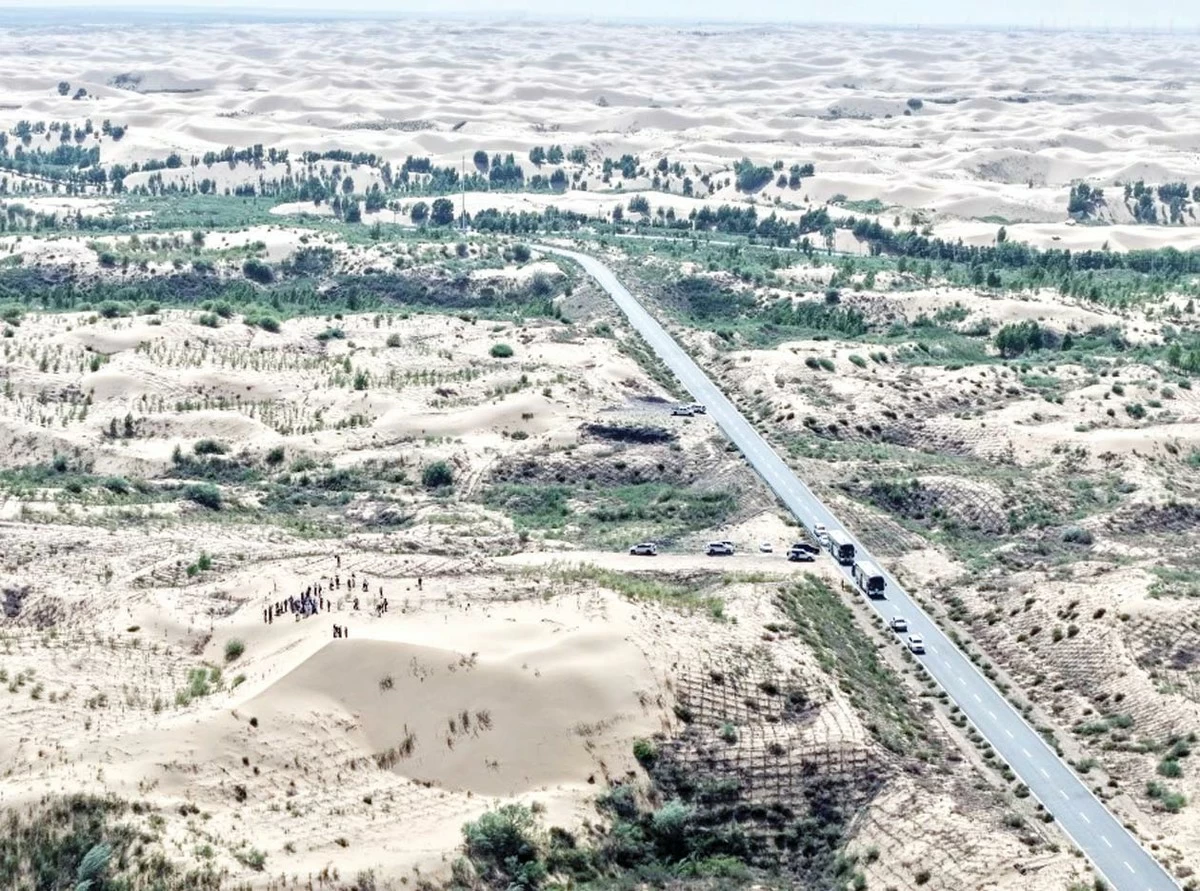
China’s ‘Green Great Wall’ tames desert growth, but scientists warn fight not over
Summarized and contextualized by DistantNews.
At a glance
News
From a news agency
Context piece
- China's "Green Great Wall" initiative, launched in 1978, has significantly combated desertification in northern regions using methods like "straw checkerboards."
- Decades of work have stabilized sand dunes, allowing vegetation to take root and reducing desertified land by over 1,000 square kilometers annually since 2000.
- While progress is measurable, scientists caution that continued effort and long-term commitment are necessary to preserve these gains against ongoing environmental challenges.
For half a century, China has waged a determined battle against encroaching deserts, transforming vast tracts of northern land through a massive afforestation program known as the "Green Great Wall."
The initiative, officially the Three-North Protective Forest Program, began in 1978. Its iconic method involves workers inserting forearm-length sticks into shifting sands to create "straw checkerboards." This technique stabilizes dunes against wind and helps saplings take root with the aid of irrigation. Generations of this labor have created a visible lattice across the landscape, symbolizing China's commitment to reclaiming land from desertification.
The results are tangible. State media reports indicate that desertified land in northern China has decreased by over 1,000 square kilometers each year since 2000. The government claims the program has been crucial in reversing the trend of "desertification advancing and people retreating," leading to greenery advancing instead. Forests planted under the program now cover an area of 500,000 square kilometers.
The broad significance of the Three-North Program is not only the scale of restoration, but the long-term political commitment behind it.
Barron Joseph Orr, chief scientist for the U.N. Convention to Combat Desertification, highlighted the program's significance, noting the "long-term political commitment" behind it. He stated that reversing desertification is achievable when integrated into long-term development strategies. Scientists like Zhu Jiaojun from the Chinese Academy of Sciences attribute the success to both "people's hard work and a bit of luck with climate," citing increased rainfall in recent years as a contributing factor.
Despite the considerable progress, scientists caution that the fight is far from over. Preserving these gains will require decades of continued effort and vigilance to counteract the persistent threats of drought, overgrazing, and unsustainable farming practices that initially led to land degradation.
The achievement of desertification combat is due to people’s hard work and a bit of luck with climate.
DistantNews Editorial
Originally published by Arab Times. Summarized and contextualized by our editorial team with added local perspective. Read our editorial standards.
More Stories



From Our Blog

What Gets Lost (and Found) When News Is Translated

The Critical Role of Diaspora Media in Global News

What Travellers Should Know About Countries with Restricted Press

A Digital Nomad's Guide to Following Local News

How the Same Story Looks Different in Different Countries
