


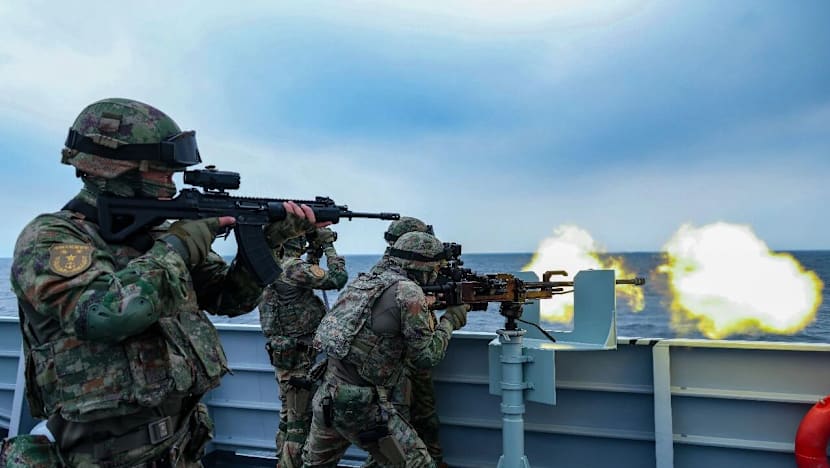
China's military moves signal strategy to normalize regional presence
Translated from English, summarized and contextualized by DistantNews.
At a glance
News
Named sources
Context piece
- China's recent military activities, including joint drills with Russia and missile tests, aim to normalize its presence in regional waters.
- Analysts suggest these actions signal Beijing's growing ability to operate across multiple domains and deter challenges from the U.S. and its allies.
- While not a single coordinated campaign, the separate activities converge to reinforce China's strategic trajectory and reaction to perceived adverse regional developments.
China's recent military maneuvers, marked by a flurry of activities including joint bomber patrols with Russia near Japan and coast guard patrols east of Taiwan, are designed to make its presence in regional waters a routine occurrence. Analysts interpret these moves as a strategic effort by Beijing to normalize its operations across multiple domains and signal its increasing capability to operate throughout the region.
The objective is normalisation, not crisis. Beijing wants its presence in these waters to become unremarkable, so the cost of challenging it rises over time.
Ben Brand, founder of Iron Command, an independent defense intelligence advisory, stated that the objective is "normalisation, not crisis." He explained that Beijing aims for its presence in these waters to become unremarkable, thereby increasing the cost for adversaries to challenge it over time. However, experts caution against viewing these actions as part of a single, coordinated campaign. Instead, they suggest the activities stem from different services, agencies, and planning cycles, with no public evidence of deliberate synchronization.
COHERENT STRATEGIC DIRECTION
The significance, according to analysts, lies in how these separate strands of Chinese activity collectively reinforce a broader message about Beijing's strategic direction. This includes joint bomber patrols over the Sea of Japan and the western Pacific, naval drills with Russia in Qingdao, continued coast guard patrols near Taiwan, and a rare missile test from a nuclear-powered submarine into the South Pacific.
The recent cluster of activity amounts to an “extraordinary confluence of public shows of China’s military might”.
Isaac Kardon, an adjunct professor at Johns Hopkins University's School of Advanced International Studies, described the recent cluster of activity as an "extraordinary confluence of public shows of China’s military might." He added that the timing and intensity likely reflect Beijing's intent to react forcefully to regional developments it perceives as adverse, such as deepening security coordination among U.S. allies and partners.
The timing and intensity of the recent activity likely reflected Beijing’s intent to react forcefully to regional developments it sees as adverse, including deepening security coordination among US allies and partners.
DistantNews Editorial
Originally published by CNA in English. Translated, summarized, and contextualized by our editorial team with added local perspective. Read our editorial standards.
More Stories

From Our Blog

What Gets Lost (and Found) When News Is Translated

The Critical Role of Diaspora Media in Global News

What Travellers Should Know About Countries with Restricted Press

A Digital Nomad's Guide to Following Local News

How the Same Story Looks Different in Different Countries
