


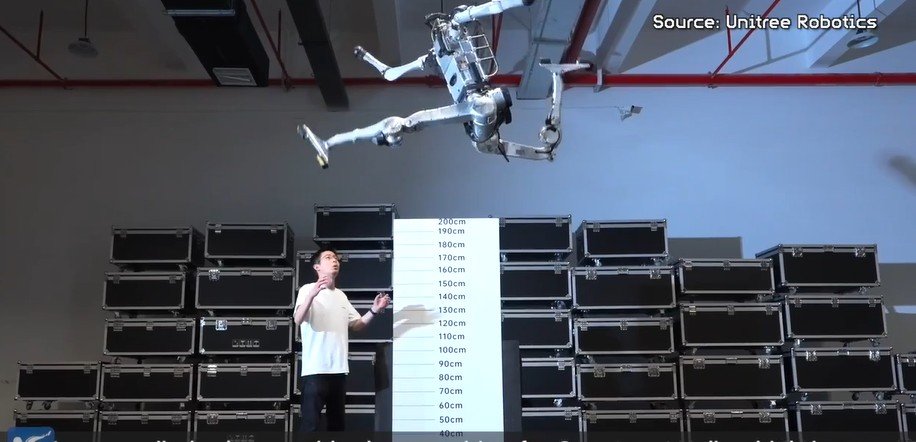
China's Unitree Surges 629% on Debut as Humanoid Robot Demand Grows
Translated from Korean, summarized and contextualized by DistantNews.
At a glance
News
Sources not specified
New plan
- Chinese humanoid robot company Unitree surged 629% on its stock market debut, opening at 1100 yuan compared to its IPO price of 150.8 yuan.
- The company's market capitalization reached 444.9 billion yuan (approximately $61.4 billion) shortly after listing.
- Unitree's revenue has grown significantly, with 2023 revenue reaching 1.676 billion yuan, a tenfold increase in two years, driven by rising demand in the robotics market.
Chinese humanoid robot developer Unitree experienced a dramatic market debut, with its stock price soaring 629% on its first day of trading on the Shanghai Stock Exchange's STAR Market. The company's shares opened at 1100 yuan, significantly higher than the initial public offering price of 150.8 yuan.
This surge propelled Unitree's market capitalization to an impressive 444.9 billion yuan (approximately $61.4 billion) shortly after trading commenced. The strong investor interest is attributed to growing optimism surrounding the potential of China's robotics industry. Despite some pullback from its peak, the stock was trading up 495.6% at 898 yuan by mid-morning.
Unitree, formerly known as Unitree Ltd., focuses on the research, development, production, and sale of high-performance general-purpose humanoid robots, quadruped robots, and robot components. Established in August 2016 and incorporated as Hangzhou Unitree Technology Co., Ltd. in May of the previous year, the company has seen substantial revenue growth. According to its IPO prospectus, revenue from its main business increased from 158 million yuan in 2023 to 388 million yuan in 2024. Last year's total revenue expanded to 1.676 billion yuan, marking a more than tenfold increase in just two years, fueled by the rapidly expanding demand in the robotics market.
DistantNews Editorial
Originally published by Dong-A Ilbo in Korean. Translated, summarized, and contextualized by our editorial team with added local perspective. Read our editorial standards.
More Stories



From Our Blog

What Gets Lost (and Found) When News Is Translated

The Critical Role of Diaspora Media in Global News

What Travellers Should Know About Countries with Restricted Press

A Digital Nomad's Guide to Following Local News

How the Same Story Looks Different in Different Countries
