


Climate change destabilizes Himalayas, melting glaciers and permafrost increase flood risk
Translated from Korean and summarized by DistantNews. Read the original for the full story.
At a glance
News
Sources not specified
Outcome reported
- Climate change is identified as a major factor in the recent catastrophic floods and landslides in the Himalayas.
- Rising temperatures are causing glaciers and permafrost to melt, destabilizing mountain slopes and increasing the risk of glacial lake outburst floods (GLOFs).
- Scientists warn that the frequency and severity of such disasters are expected to rise, necessitating early warning systems for downstream communities.
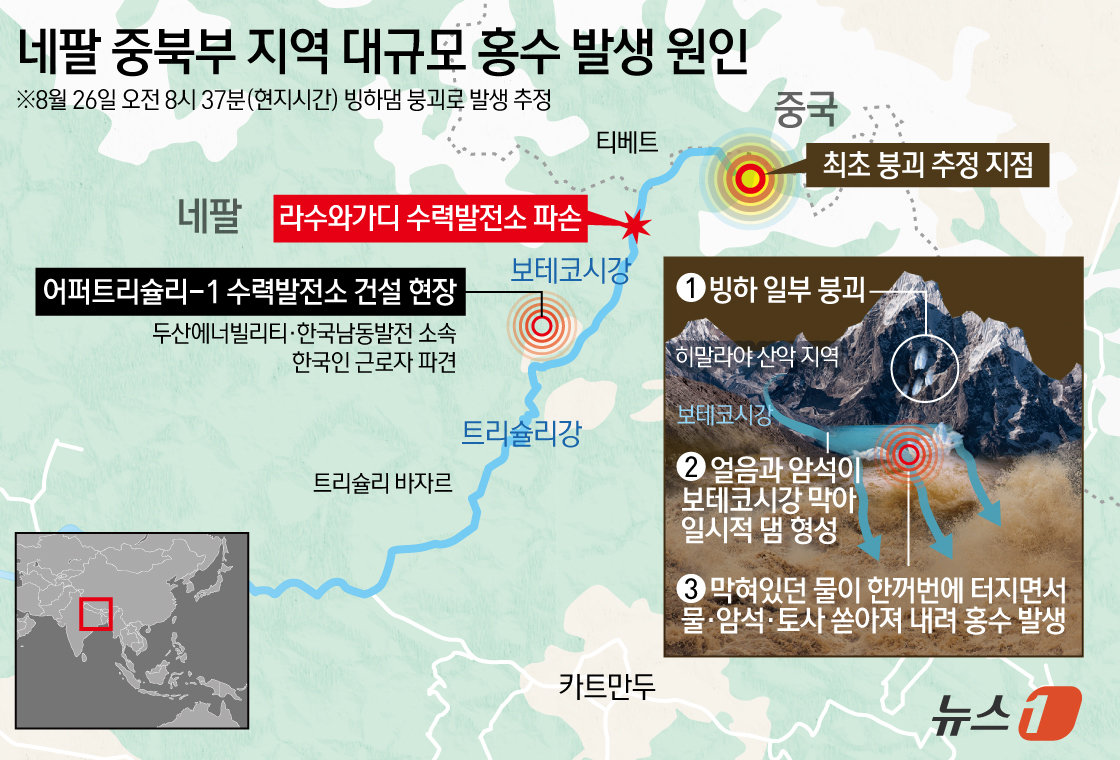
A catastrophic flood and landslide event in the Himalayas, affecting Nepal and the Tibet region of China, has claimed hundreds of lives and left many more missing. Scientists are increasingly pointing to climate change as a primary driver of this disaster. The rising temperatures in the high-altitude Himalayan regions are accelerating the melting of glaciers and permafrost, which in turn destabilizes the mountain slopes.
We are seeing these slopes become more susceptible to collapse as glaciers retreat and permafrost melts. There is a very direct link between climate change and these types of disasters.
Geologists and glaciologists suggest that the disaster was likely triggered by a massive glacial collapse, sending ice and rock cascading into the valley. Some analyses indicate a simultaneous collapse of both glaciers and bedrock. While an earthquake was initially recorded in the area, subsequent analysis suggests the landslide itself generated seismic signals. The scale of the landslide, estimated to be equivalent to a magnitude 5.2 event, highlights the immense forces at play.
Experts like Professor Asim Sattar from the Indian Institute of Technology Bhubaneswar explain that as glaciers retreat and permafrost thaws, these slopes become more vulnerable to collapse. He stated, "We are seeing these slopes become more susceptible to collapse as glaciers retreat and permafrost melts. There is a very direct link between climate change and these types of disasters." This phenomenon is exacerbated by reduced surface reflectivity as snow and ice disappear, leading to greater absorption of solar energy and further warming of mountain permafrost.
The high temperatures are likely to have filled crevasses with water, weakening the bonds between the ice and rock that hold the glacier together.
The melting of glaciers is also contributing to the formation of unstable glacial lakes. As these lakes grow larger, the risk of a Glacial Lake Outburst Flood (GLOF) increases significantly if the natural dams holding them back are breached. The Himalayas are warming at twice the global average rate, and the United Nations has warned that the risk of GLOFs in the region could triple by the end of this century. Dr. Hamish Pritchard of the British Antarctic Survey emphasized the urgency of implementing early warning systems to protect communities living in the valleys below.
The volume of water seen in the footage is astonishingly high, and is an order of magnitude larger than in similar recent glacial disasters. It is very likely that there is another cause.
However, pinpointing the exact cause of this specific flood remains complex. The estimated 50 million cubic meters of water released far exceeds typical GLOF volumes, leading some experts to suggest that other factors may be involved. Dr. Daniel Sugar, a geologist at the University of Calgary, noted that the sheer volume of water seen in footage is significantly larger than in similar recent disasters. Glaciologist Adrien Gilbert of the French National Centre for Scientific Research (CNRS) added that understanding the origin of this immense water volume is a critical question, with landslide-induced dam breaks being a possibility, though not yet fully explained.
One of the important questions is to understand where this enormous amount of water came from. It is possible that a landslide created a reservoir that was then suddenly released, but at this stage, it remains unexplained.
About this summary
Originally published by Dong-A Ilbo in Korean. Translated, summarized, and contextualized automatically by DistantNews, with a note on how the source frames the story. Not individually reviewed before publishing. How this works.
More Stories


From Our Blog

What Gets Lost (and Found) When News Is Translated

The Critical Role of Diaspora Media in Global News

What Travellers Should Know About Countries with Restricted Press

A Digital Nomad's Guide to Following Local News

How the Same Story Looks Different in Different Countries
