


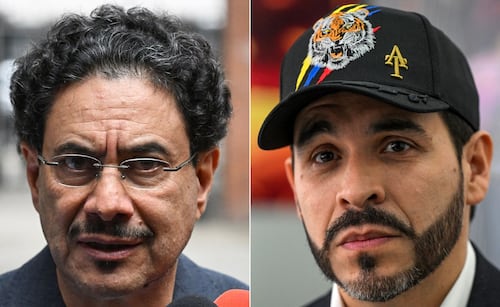
Colombian conservative accuses 'vote under threat'; rival claims opponent plans self-attack
Translated from Spanish, summarized and contextualized by DistantNews.
At a glance
News
Named sources
Context piece
- Conservative candidate Abelardo de la Espriella accused armed groups of pressuring voters in municipalities where rival Iván Cepeda received high support.
- De la Espriella asked the prosecutor's office to investigate "vote under threat" in 109 municipalities, primarily in Cauca, Nariño, and Chocó.
- Cepeda's campaign has not yet responded, while both candidates have accused each other of electoral irregularities.
Conservative presidential candidate Abelardo de la Espriella has formally requested the prosecutor's office investigate alleged coercion of voters by illegal armed groups during the first round of Colombia's presidential election. De la Espriella claims this "vote under threat" practice occurred in approximately 100 municipalities where his progressive rival, Iván Cepeda, secured a significant majority of votes.
The complaint specifically targets 109 municipalities across the volatile southwestern departments of Cauca and Nariño, and the western department of Chocó. De la Espriella highlighted that these areas largely overlap with territories identified as high-risk for electoral violence by the state's Ombudsman's Office. He stated that being forced to vote under threat is incompatible with democracy.
In the first round, de la Espriella garnered 43.73% of the vote, narrowly ahead of Cepeda's 40.91%. The two will face each other in a runoff election on June 21. Both campaigns have leveled accusations of irregularities against each other, including alleged vote-buying.
Cepeda's campaign has not yet responded to the specific allegations of armed group pressure. However, Cepeda has previously accused de la Espriella of planning a "staged self-attack" to influence the election outcome. The risk of violence from illegal groups in numerous municipalities was a recurring warning throughout the campaign from both the Ombudsman's Office and the independent Electoral Observation Mission.
DistantNews Editorial
Originally published by El Universal in Spanish. Translated, summarized, and contextualized by our editorial team with added local perspective. Read our editorial standards.
More Stories
From Our Blog

What Press Freedom Means for the News You Read

What Gets Lost (and Found) When News Is Translated

The Critical Role of Diaspora Media in Global News

What Travellers Should Know About Countries with Restricted Press

A Digital Nomad's Guide to Following Local News
