


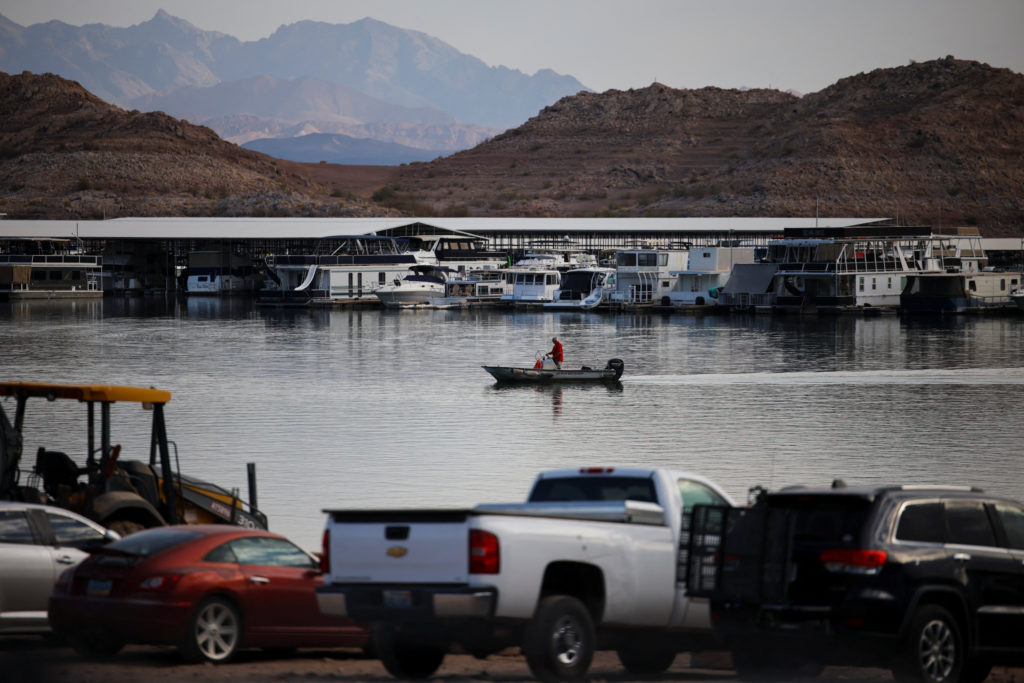
Colorado River Drought Plan Sparks Uncertainty for Western Cities and Farmers
Translated from English and summarized by DistantNews. Read the original for the full story.
At a glance
News
From a news agency
Context piece
- A new federal plan to cut water use from the Colorado River amid a deepening drought offers little relief to communities facing dwindling supplies.
- Cities like Cave Creek, Arizona, are already capping growth and reviving old wells, while farmers weigh crop investments amid rising uncertainty.
- Nevada is suing the Interior Department over planned reductions, highlighting the widespread impact and legal challenges arising from the crisis.
On the outskirts of Phoenix, the small town of Cave Creek exemplifies the growing anxiety over the Colorado River's dwindling flow. Mayor Robert Morris described the situation as akin to preparing for a meteor strike – a looming disaster that is visible but unavoidable, with unpredictable consequences. Cave Creek, which relies almost entirely on the river, has already implemented water cuts and faces further reductions under a new federal plan. This plan aims to address the crisis affecting 40 million people across the U.S. West, but it introduces significant uncertainty for communities, farmers, and industries dependent on the river.
The uncertainty ripples across seven U.S. states, tribal nations, and Mexico. Farmers are reassessing which crops are economically viable given the water scarcity. Major cities like Phoenix might face municipal and industrial water cuts for the first time, forcing them to rely on backup supplies. The situation is so dire that Nevada has escalated the crisis by suing the Interior Department and the U.S. Bureau of Reclamation. The state argues that planned reductions of up to 70% of its Colorado River water over the next decade will leave the Las Vegas region unable to meet basic needs.
You can see it coming, but you can't get out of the way and you don't know what the damage is going to be.
Record low levels in Lake Mead and Lake Powell, the two largest reservoirs in the U.S. and key indicators for the Colorado River system, underscore the severity of the drought, exacerbated by climate change, demand, and overuse. A severe snow drought has further limited the recharge of essential water sources like reservoirs, aquifers, and snowpacks. Eight other Bureau of Reclamation reservoirs have also recorded their lowest levels in at least 30 years, impacting agricultural regions in New Mexico, Texas, Mexico, and parts of Colorado and Nebraska.
The Bureau of Reclamation's plan mandates a collective reduction of 1.25 million acre-feet of water annually from California, Nevada, and Arizona over the next two years. This amount is equivalent to over 600,000 Olympic-sized swimming pools. The plan allows for potentially larger cuts depending on future conditions, while Colorado, Utah, Wyoming, and New Mexico are not yet subject to these specific mandatory reductions. Tom Buschatzke, director of the Arizona Department of Water Resources, warned that the uncertainty is building in the wrong direction, reflecting a grim outlook for water management in the region.
The uncertainty is going to continue to build in the wrong direction.
About this summary
Originally published by PBS NewsHour in English. Translated, summarized, and contextualized automatically by DistantNews, with a note on how the source frames the story. Not individually reviewed before publishing. How this works.
More Stories


From Our Blog

How the Same Story Looks Different in Different Countries

What Gets Lost (and Found) When News Is Translated

The Critical Role of Diaspora Media in Global News

What Travellers Should Know About Countries with Restricted Press

A Digital Nomad's Guide to Following Local News
