


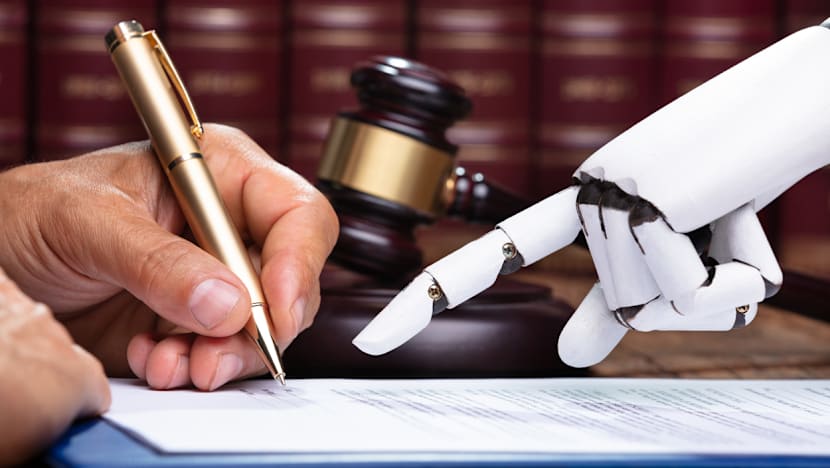
Commentary: AI Chatbots Pose Risks to Legal Advice Accuracy and Confidentiality
Translated from English, summarized and contextualized by DistantNews.
At a glance
News
Named sources
Context piece
- The rise of generative AI presents significant challenges and risks for the legal profession, prompting widespread concern among lawyers.
- AI chatbots, while offering speed and cost savings, are prone to "hallucinations," citing fictitious cases, which can have serious legal consequences.
- Lawyers provide essential safeguards like confidentiality and nuanced judgment that AI currently cannot replicate, making human legal counsel indispensable.
The rapid advancement of generative artificial intelligence is causing considerable introspection within the legal field, with concerns mounting over its impact on legal practice and the future job prospects for lawyers. Chief Justice Sundaresh Menon has noted that AI is poised to fundamentally alter how law is practiced and how legal professionals are trained.
AI would 'upend the practice of law and the way we train and develop lawyers'.
Junior lawyers and recent graduates are particularly anxious about AI's growing capabilities. A recent survey indicated that one in three new lawyers considers leaving the profession within three years, a trend that job anxiety fueled by AI is likely to exacerbate. Tools like Anthropic's Claude Legal automate tasks such as contract reviews and legal brief writing, signaling a potential disruption to traditional legal workflows and impacting software and services stocks.
Why engage and pay a lawyer if a chatbot can do the same work in a matter of seconds for a fraction of the cost?
A significant risk associated with AI in legal contexts is "hallucination" – the generation of inaccurate or fabricated information. This was starkly illustrated when a family court magistrate discovered a man citing 14 fictitious cases found via ChatGPT in his legal submissions. Similarly, two Singaporean lawyers were fined for citing non-existent cases in court. With a high percentage of new lawyers utilizing AI, understanding and mitigating these "hallucinations" is critical.
While AI providers have improved the reliability of their legal tools, the risk of hallucination is inherent in Large Language Models (LLM) and cannot be fully eliminated.
Beyond accuracy, human lawyers offer a crucial element of confidentiality that AI tools lack. Unlike communications with a lawyer, which are protected by privilege, information shared with AI chatbots may not be secure, as demonstrated in a case where an ex-CEO's AI chats were accessible to prosecutors. While AI can offer efficiency and cost-effectiveness, the inherent risks of inaccuracy and the absence of privileged communication underscore the continued necessity of human legal expertise for reliable advice and representation.
The only way to verify those cases is to find, read and analyse them, something that lawyers are better placed to do than the lay person.
DistantNews Editorial
Originally published by CNA in English. Translated, summarized, and contextualized by our editorial team with added local perspective. Read our editorial standards.
More Stories



From Our Blog

What Gets Lost (and Found) When News Is Translated

The Critical Role of Diaspora Media in Global News

What Travellers Should Know About Countries with Restricted Press

A Digital Nomad's Guide to Following Local News

How the Same Story Looks Different in Different Countries
