


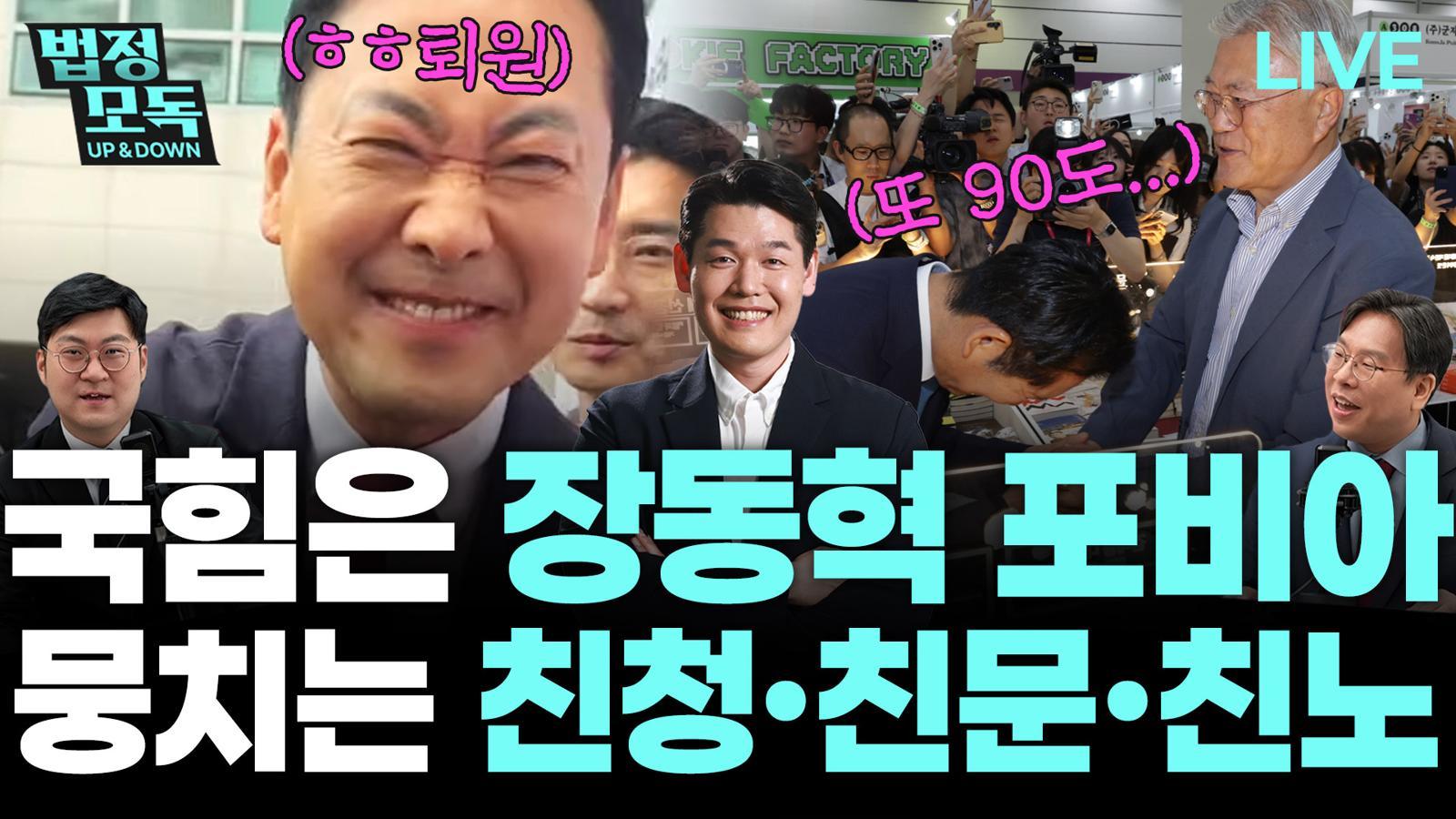
Commentary: Jeong Cheong-rae's resignation statement declared him Lee's equal
Translated from Korean, summarized and contextualized by DistantNews.
At a glance
Analysis
Sources not specified
Context piece
- A South Korean political commentary program discussed the ruling People Power Party's internal dynamics and potential strategies for the upcoming general election.
- Analysts debated the leadership of party chairman Jang Dong-hyuk and suggested internal pressure from floor leader Jeong Jin-suk.
- The commentary also touched upon the political positioning of former Democratic Party leader Jeong Cheong-rae and the implications of his resignation statement.
A South Korean political commentary program, "Legal Mockery," hosted by Dong-A Ilbo, delved into the internal struggles of the ruling People Power Party and the broader political landscape.
Now, the pro-Yoon mainstream absolutely does not think that Chairman Jang Dong-hyuk will make it to the next general election.
Analysts on the program suggested that the current leadership under Chairman Jang Dong-hyuk might not last until the next general election. Park Sang-soo, a lawyer, argued that the "pro-Yoon" faction, representing President Yoon Suk-yeol's allies, is in its "final moment of holding onto vested interests." He posited that floor leader Jeong Jin-suk is subtly increasing pressure on Jang, employing a "calm but steady" approach to "tighten the noose" around the chairman.
Floor leader Jeong Jin-suk is exercising his political power in his own way. He is steadily tightening the noose around Chairman Jang Dong-hyuk in a calm but steady manner.
The discussion also touched upon the controversial resignation statement of former Democratic Party leader Jeong Cheong-rae. Park suggested that Jeong's words, which alluded to solidarity with President Lee Jae-myung, effectively declared himself and the president as equals. He interpreted this as a strategic move, implying a desire to protect Lee and a demand for a leadership position within the party in return for this protection. "We are an alliance, but how can you try to take everything?" Park questioned, suggesting Jeong's statement was a declaration that his faction would protect Lee, but in return, he expected the party leadership.
Lee Jun-seok always does not acknowledge second place. He only insists on his own hegemony.
Further analysis explored the perception among some People Power Party members that the current leadership structure is insufficient for electoral victory. The program also briefly touched upon the conservative political figure Han Dong-hoon, with lawyer Kang Soo-young suggesting that Han should learn from Lee Jun-seok, leader of the Reform Party, who is characterized as unwilling to accept second place and insistent on his own views. Kang implied that Han's approach of forgiving past grievances and adopting a more conciliatory tone, as seen in recent media appearances, might be a strategic shift.
Jeong Cheong-se's resignation statement is a declaration that he is essentially on the same level as President Lee Jae-myung.
DistantNews Editorial
Originally published by Dong-A Ilbo in Korean. Translated, summarized, and contextualized by our editorial team with added local perspective. Read our editorial standards.
More Stories


From Our Blog

What Gets Lost (and Found) When News Is Translated

The Critical Role of Diaspora Media in Global News

What Travellers Should Know About Countries with Restricted Press

A Digital Nomad's Guide to Following Local News

How the Same Story Looks Different in Different Countries
