


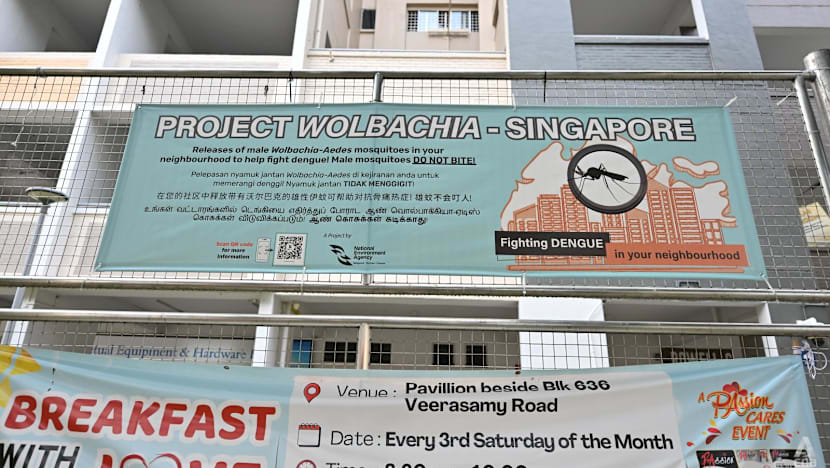
Commentary: The real achievement behind 10 years of Project Wolbachia in Singapore’s dengue fight
Summarized and contextualized by DistantNews.
At a glance
News
Sources not specified
Context piece
- Singapore has successfully scaled up Project Wolbachia, releasing 15 million mosquitoes weekly to control dengue.
- The project uses male Aedes aegypti mosquitoes carrying the Wolbachia bacteria, which prevents eggs from hatching, significantly reducing mosquito populations.
- A decade after its launch, the project has achieved substantial reductions in dengue cases and mosquito populations, translating a scientific breakthrough into a public health reality.
Singapore's decade-long commitment to Project Wolbachia has transformed a scientific concept into a large-scale public health success, significantly curbing dengue transmission in the urban nation.
Science breakthroughs don’t always become public health reality. Here’s how Singapore did it with mosquitoes and dengue, say NTU’s Lim Jue Tao and NEA’s Tan Cheong Huat, Chong Chee-Seng and Ng Lee Ching.
Launched in 2016 with a modest release of 3,500 mosquitoes, the project now involves the weekly release of up to 15 million Wolbachia-carrying male Aedes aegypti mosquitoes. This strategy leverages a naturally occurring bacterium, Wolbachia, which, when present in male mosquitoes, renders the eggs of wild females unhatchable. This biological control method has proven remarkably effective in suppressing Aedes aegypti populations, the primary vector for dengue and Zika.
The impact has been substantial. A large-scale trial published in the New England Journal of Medicine demonstrated an 80 to 90 percent reduction in Aedes aegypti populations in treated areas. Consequently, residents in these areas experienced a 72 percent decrease in their dengue risk, with even adjacent untreated areas seeing a 45 percent reduction.
Releasing mosquitoes to prevent disease may still sound counterintuitive, but Project Wolbachia has quietly demonstrated its worth.
Translating this laboratory discovery into a sustained national program presented significant challenges, particularly in Singapore's dense, high-rise urban environment. Early trials revealed that mosquitoes did not fly high enough to protect residents on upper floors, and initial release areas were too small. These hurdles spurred innovation, leading to expanded release zones and pioneering methods for deployment in multi-storey buildings, ultimately achieving the sustained population suppression seen today.
In a large-scale trial published in the New England Journal of Medicine, areas treated with Wolbachia-Aedes mosquitoes saw 80 per cent to 90 per cent reduction in Aedes aegypti populations.
While other countries like China and the United States have conducted smaller-scale trials of Wolbachia technology, Singapore stands out as the first to implement it efficiently on a national scale. By the end of 2026, Project Wolbachia is set to cover more than half of Singaporean households, marking a significant achievement in public health innovation.
Residents in treated areas had their dengue risk reduced by 72 per cent, while those living in adjacent untreated sites also benefited from a 45 per cent reduction.
DistantNews Editorial
Originally published by CNA. Summarized and contextualized by our editorial team with added local perspective. Read our editorial standards.
More Stories



From Our Blog

What Gets Lost (and Found) When News Is Translated

The Critical Role of Diaspora Media in Global News

What Travellers Should Know About Countries with Restricted Press

A Digital Nomad's Guide to Following Local News

How the Same Story Looks Different in Different Countries
