

Conagua reduces Culex mosquito presence at Endhó dam in Hidalgo, maintains fumigation strategy
Translated from Spanish, summarized and contextualized by DistantNews.
At a glance
News
Sources not specified
Context piece
- The National Water Commission (Conagua) has reduced the presence of the Culex mosquito in the Endhó dam in Hidalgo, Mexico.
- Larval density decreased from 180 to 95 per square meter, and adult mosquito populations dropped from 143 to 76 per trap.
- These results confirm the effectiveness of ongoing fumigation and control strategies, with plans to maintain permanent monitoring and operational adjustments.
The National Water Commission (Conagua) reports favorable results in its campaign to control the Culex mosquito at the Endhó dam in Hidalgo, Mexico. Mayela Godínez Alarcón, manager of Water Planning, stated that the first phase of the dam's Master Recovery Plan has successfully reduced both larval and adult mosquito populations.
the first phase of the Plan Maestro de Recuperación de la presa Endho maintains favorable results in the control of this insect.
Monitoring data shows a significant decrease in larval density, falling from 180 to 95 larvae per square meter across five sampling points. Similarly, adult mosquito populations captured in traps in 34 riverside communities dropped from an average of 143 to 76 individuals. These figures indicate that consistent control measures are effective in managing the pest.
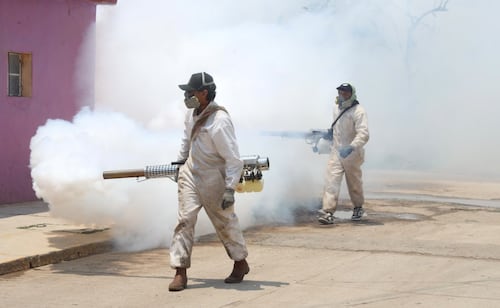
Conagua acknowledged that dam recovery is a long-term process, emphasizing the need for a permanent strategy to ensure lasting results. The commission continues its fumigation efforts in 27 priority riverside communities, benefiting over 27,000 residents. These actions involve ground fumigation in more than 9,000 homes, utilizing equipment like ULV, thermal foggers, and sprayers. Some communities have received up to seven fumigation treatments.
these results confirm that the periodic application of control measures contributes to reducing the presence of the plague and support the continuity of a strategy based on permanent monitoring and operational adjustments.
The agency highlighted the use of advanced technology, including drones, to detect areas with higher mosquito concentrations. Despite the dam's 1,264-hectare surface area, fumigation efforts have covered over 2,700 hectares, demonstrating a comprehensive approach to the control strategy.
the recovery of the dam will not be achieved with a single intervention, so a permanent strategy is maintained that allows consolidating a lasting recovery, despite the favorable results obtained to date.
DistantNews Editorial
Originally published by El Universal in Spanish. Translated, summarized, and contextualized by our editorial team with added local perspective. Read our editorial standards.
More Stories

From Our Blog

What Press Freedom Means for the News You Read

What Gets Lost (and Found) When News Is Translated

The Critical Role of Diaspora Media in Global News

What Travellers Should Know About Countries with Restricted Press

A Digital Nomad's Guide to Following Local News
