


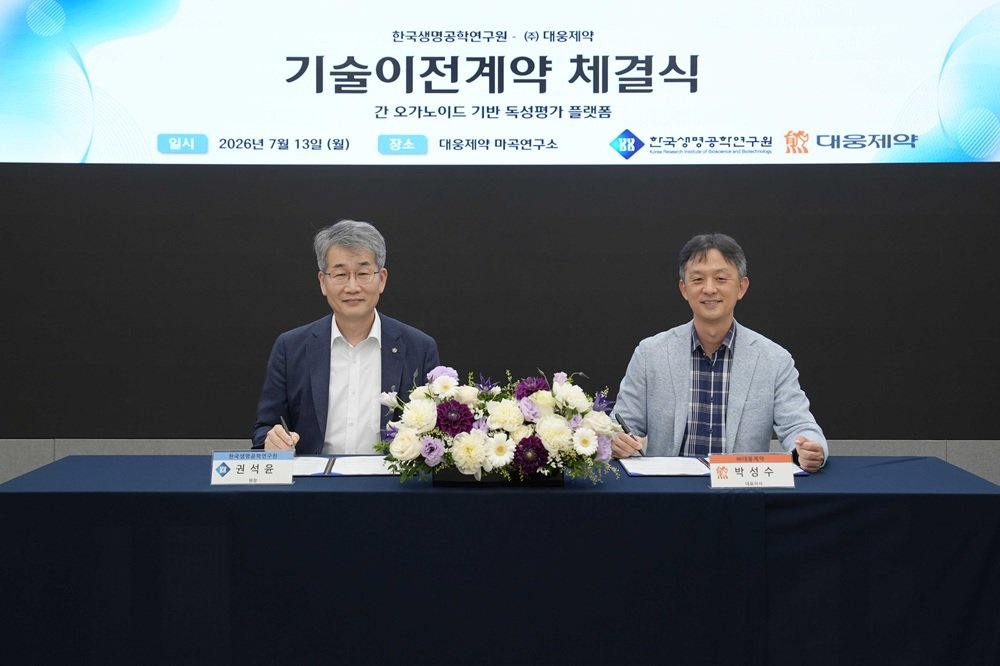
Daewoong Pharma licenses KRIBB's 'mini-liver' tech for drug toxicity tests
Translated from Korean, summarized and contextualized by DistantNews.
At a glance
News
Named sources
New plan
- Daewoong Pharmaceutical has licensed "mini-liver" technology from the Korea Research Institute of Bioscience and Biotechnology (KRIBB).
- This technology uses 3D-cultured organoids to replicate human liver functions for drug toxicity testing.
- The "mini-liver" aims to improve the accuracy of preclinical drug toxicity assessments, reduce development costs, and align with global trends favoring non-animal testing methods.
Daewoong Pharmaceutical is set to enhance its new drug development process by integrating cutting-edge "mini-liver" technology acquired from the Korea Research Institute of Bioscience and Biotechnology (KRIBB). The company announced on the 15th that it has signed a technology transfer agreement for KRIBB's "liver organoid production and drug evaluation technology."
Liver organoids are three-dimensional structures cultured from stem cells, designed to mimic the structure and some functions of a human liver. They are crucial for evaluating the potential liver toxicity and drug responses of new drug candidates. The technology licensed by Daewoong was developed by Dr. Son Myung-jin's team at KRIBB, featuring a "3D human liver organoid production and toxicity evaluation platform."
We have secured a research platform that can precisely evaluate new drug candidates. We will apply liver organoid technology to the actual new drug development process to increase research efficiency.
Traditional drug development has relied on 2D liver cell cultures or animal models for toxicity testing. However, these methods have limitations in accurately predicting toxicity observed in human clinical trials due to differences from actual human liver physiology. KRIBB's organoid technology distinguishes itself by replicating not only liver cells but also the bile duct structures within the liver, allowing for a comprehensive assessment of how drug candidates affect both.
This advanced platform supports long-term culture and repeated proliferation, with preserved function even after freezing and thawing, making it suitable for mass production and repeated testing. The technology is also undergoing expert review for adoption into OECD Test Guidelines and new ISO international standards, potentially establishing it as a global benchmark for toxicity evaluation. Daewoong Pharmaceutical plans to apply this technology to preclinical assessments, aiming to identify high-risk substances early, thereby reducing development failures and costs. This move also aligns with the increasing global regulatory trend, including from the U.S. FDA, to reduce reliance on animal testing and adopt alternative methods like cell and organoid-based assays.
It is meaningful that the organoid technology developed by a public research institution can be utilized in the pharmaceutical industry's new drug development. We will continue with follow-up research and technological advancement.
DistantNews Editorial
Originally published by Dong-A Ilbo in Korean. Translated, summarized, and contextualized by our editorial team with added local perspective. Read our editorial standards.
More Stories



From Our Blog

What Gets Lost (and Found) When News Is Translated

The Critical Role of Diaspora Media in Global News

What Travellers Should Know About Countries with Restricted Press

A Digital Nomad's Guide to Following Local News

How the Same Story Looks Different in Different Countries
