


David Hockney depicted a 'peaceful, gay paradise' when homosexuality was a crime
Summarized and contextualized by DistantNews.
At a glance
In-depth
From a news agency
Context piece
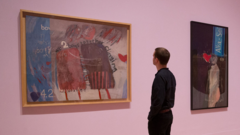
- David Hockney's 1961 painting "We Two Boys Together Clinging" depicted a same-sex couple when homosexuality was illegal in the UK.
- The artwork, inspired by a Walt Whitman poem, was an early expression of the artist's identity and a challenge to social taboos.
- Hockney continued to explore same-sex relationships in his art throughout the 1960s, contributing to the normalization of gay life.
David Hockney's 1961 painting "We Two Boys Together Clinging" offered a radical depiction of a same-sex couple at a time when homosexuality was a crime in the UK. Created during his second year at the Royal College of Art and inspired by Walt Whitman, the artwork served as an early statement of intent from an artist who would become a defining figure in British and LGBT+ culture. Hockney's early work often carried an "underground quality," described as "spiky, expressive and defiant," reminiscent of graffiti with bold lines and block colors.
He was really pioneering as somebody who was unashamedly proud of his queerness before the legalisation of homosexuality in '67.
Dominic James Bilton, co-leader of the Queer British Art Network, notes Hockney's pioneering role, stating he was "unashamedly proud of his queerness before the legalisation of homosexuality in '67." Bilton highlights that Hockney "showed and made work on same-sex relationships and desire and sexuality" when few others were doing so. His art celebrated same-sex relationships, often by portraying the quiet, everyday moments of gay domestic life, thereby "normalising same-sex relationships... that we take for granted."
showed and made work on same-sex relationships and desire and sexuality
Hockney's style evolved significantly after his first trip to California in 1964, leading to his famous swimming pool paintings. Works like the 1966 "Peter Getting Out of Nick's Pool" and the 1963 "Domestic Scene, Los Angeles" continued to explore queer themes with "sensual and sexy and playful and joyous" elements, while also depicting the "domesticity" and "dull aspects of gay relationships." These pieces, according to Bilton, showed that gay people "are just normal people... doing normal stuff, looking at our partners and thinking: 'oh, you're beautiful.'" The enduring impact of Hockney's art is evident, with fans like Joe Thomas even getting "A Bigger Splash" tattooed on his leg, recalling the "awe and deep peace" he felt viewing the painting.
Those works are so queer, so sensual and sexy and playful and joyous.
DistantNews Editorial
Originally published by BBC News. Summarized and contextualized by our editorial team with added local perspective. Read our editorial standards.
More Stories

From Our Blog

What Gets Lost (and Found) When News Is Translated

The Critical Role of Diaspora Media in Global News

What Travellers Should Know About Countries with Restricted Press

A Digital Nomad's Guide to Following Local News

How the Same Story Looks Different in Different Countries
