


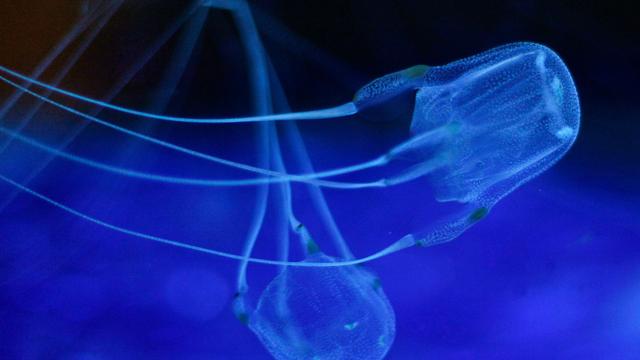
Deadly danger at sea: 13-year-old dies after box jellyfish sting in Thailand
Translated from German, summarized and contextualized by DistantNews.
At a glance
News
Official statement
Context piece
- A 13-year-old boy died in southern Thailand after being stung by a highly venomous box jellyfish.
- The incident occurred while the teenager was swimming at Ban Fai Tha Beach in Nakhon Si Thammarat province.
- Authorities have increased warnings and safety measures at beaches due to the presence of these dangerous marine creatures.
A young boy's life was tragically cut short in southern Thailand after a sting from a deadly box jellyfish. The 13-year-old was swimming at Ban Fai Tha Beach in Nakhon Si Thammarat province when the fatal encounter occurred.
Box jellyfish, also known as sea wasps, are among the most venomous marine animals globally. While primarily found along the coasts of Australia, they inhabit the wider Indo-Pacific region. Their potent venom can cause immediate, severe pain and rapidly damage the heart and nervous system, potentially leading to respiratory or cardiac arrest within minutes.
Box jellyfish belong to the most poisonous sea creatures in the world and live mainly on the north and east coasts of Australia, predominantly in shallow waters. However, they occur throughout the Indo-Pacific.
This incident is not the first fatal encounter with box jellyfish in Thailand. Previous deaths have been reported near popular tourist islands like Koh Samui and Koh Phangan. A German girl died from a sting in 2015, and a French boy in 2014, with an Israeli child also succumbing in 2021.
The regional offices have been instructed to work with provincial administrations, health authorities and beach operators to continuously monitor endangered coastal sections and warn the public.
In response to the latest tragedy, authorities have intensified warnings and implemented enhanced safety measures along the coast. The Department of Marine and Coastal Resources (DMCR) has instructed regional offices to collaborate with provincial administrations and health authorities to continuously monitor vulnerable coastal areas and alert the public. Beachgoers are urged to avoid entering the water if jellyfish are sighted and to follow lifeguard instructions. They are also warned never to touch jellyfish with bare hands.
First aid protocols emphasize immediately removing the victim from the water and rinsing the wound with household vinegar for at least 30 seconds. Authorities explicitly caution against using fresh water or alcohol, or rubbing the wound, as these actions can release more venom. Emergency vinegar stations have been set up along affected beaches, mirroring practices in Australia where nets protect swimmers and vinegar is standard lifeguard equipment.
After a sting, those affected should be immediately removed from the water and the wound should be rinsed with household vinegar for at least 30 seconds.
DistantNews Editorial
Originally published by Die Zeit in German. Translated, summarized, and contextualized by our editorial team with added local perspective. Read our editorial standards.
More Stories


From Our Blog

What Gets Lost (and Found) When News Is Translated

How the Same Story Looks Different in Different Countries

The Critical Role of Diaspora Media in Global News

What Travellers Should Know About Countries with Restricted Press

A Digital Nomad's Guide to Following Local News
